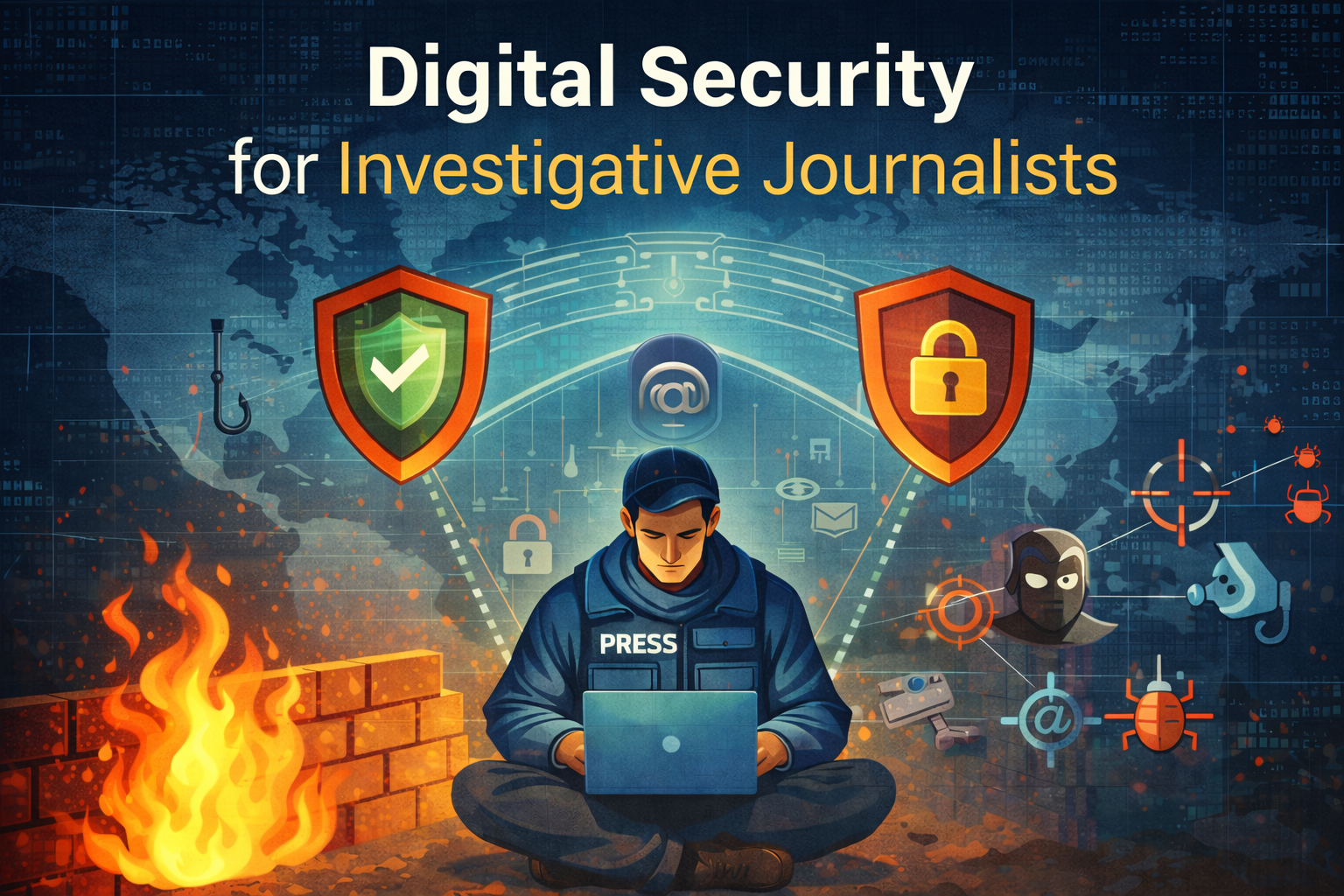
Investigative journalism increasingly unfolds in environments shaped by surveillance, data exploitation, harassment, and cybercrime. Whether reporting on corruption, conflict, extremism, or powerful institutions, journalists today must assume that digital risk is part of the job.
Digital self-defense is therefore no longer optional. It is a professional responsibility—toward oneself, one’s colleagues, and, critically, one’s sources.
This guide distills best practices, field-tested strategies, and practical tools shared during international investigative journalism trainings, including sessions at Dataharvest 2025. It is designed as a baseline framework that can be adapted to different threat models, regions, and newsroom capacities.
Understanding the Threat Landscape
Journalists face multiple categories of digital adversaries, often simultaneously:
• Cybercriminals, motivated by financial gain, using phishing, malware, and ransomware at scale
• State and state-aligned actors, conducting targeted surveillance, device compromise, and metadata collection
• Antisocial actors, including trolls, doxxers, and harassment networks seeking intimidation and silencing
Effective self-defense begins with risk assessment: understanding who may want your data, why, and how far they are willing to go.
A Baseline for Digital Safety
Digital security does not start with advanced tools—it starts with habitual discipline. A strong baseline dramatically reduces risk, even against sophisticated threats.
A solid baseline includes:
1. Keeping devices and software updated
Security updates patch known vulnerabilities. Delaying updates creates avoidable exposure.
2. Taking regular backups
Backups protect against ransomware, device loss, and accidental deletion. They should be encrypted and tested.
3. Being aware of phishing
Phishing remains the most common entry point for attacks. Journalists should treat unexpected links, attachments, and login requests with extreme caution—especially under emotional pressure or urgency.
4. Using a password manager and two-factor authentication (2FA)
Unique, strong passwords and 2FA prevent account takeovers even when credentials are leaked.
5. Using encrypted communication and storage
Sensitive reporting requires end-to-end encrypted messaging, encrypted files, and secure collaboration platforms.
These practices form the minimum professional standard, not an advanced setup.
Digital Hygiene as a Daily Practice
Digital security is best understood as a form of public health: small, consistent actions taken by many people reduce overall risk.
Rather than seeking perfect security, journalists should aim for risk reduction through routine hygiene:
• Lock devices when unattended
• Avoid using shared or unknown hardware
• Separate personal and professional accounts
• Minimize the data stored locally
• Delete what is no longer needed
Security failures are often not technical—they are behavioral.
The Swiss Cheese Model of Security

No single tool or practice can provide complete protection. Each layer has weaknesses. Combined, however, they significantly reduce the chance of a successful attack.
In practice, layered security includes:
• Device encryption
• Strong authentication
• Access control
• Network protection
• Secure user behavior
An attacker must pass through multiple imperfect barriers—making compromise harder, noisier, and more detectable.
Travel and Field Reporting: Before, During, After
Journalists working across borders or in sensitive locations face elevated digital risks. Preparation and follow-up are as important as behavior in the field.


Before Departure
• Assess political context and internet freedom
• Identify likely adversaries (criminal, state, social)
• Update devices and software
• Back up and encrypt data
• Remove non-essential files and accounts
During Travel
• Never leave devices unattended
• Power off devices at borders and checkpoints
• Use encrypted communication channels
• Avoid public or unknown networks without protection
• Be alert to phishing and impersonation attempts
After the Trip
• Change passwords
• Examine devices for anomalies
• Clean and restore from backups if needed
• Report incidents to editors or security teams
Tools: Building a Responsible Toolkit
A journalist’s digital toolkit should be fit for purpose, transparent, and aligned with their threat model.
Commonly recommended categories include:
• Encrypted messaging and calling
• Secure file sharing and storage
• Password management
• Privacy-respecting search and browsing
• Secure note-taking and collaboration
• Hardened operating systems for high-risk work
Open-source and non-profit tools are often preferred due to transparency, auditability, and reduced exposure to commercial data exploitation.
No tool guarantees safety. How tools are used matters as much as which tools are chosen.
Security Is a Collective Responsibility
Digital self-defense is not only about protecting oneself. A single compromised journalist can expose:
• Sources
• Colleagues
• Entire investigations
Strong security practices protect the ecosystem of trust on which investigative journalism depends.
As one experienced reporter observed:
When the work is done well, the story appears.
What remains invisible is everything that had to be protected to make it possible.
Digital self-defense is now a core journalistic skill. It requires awareness, discipline, and shared responsibility—not fear or technical obsession.
By establishing a strong baseline, practicing layered security, and integrating safety into daily workflows, investigative journalists can continue to report on powerful interests without becoming unnecessary targets themselves.
Security does not replace courage; It enables it.