

At the end of each day, Haider, a trader in Baghdad’s Jamila wholesale market, gathers the proceeds from his sales in Iraqi dinars. Tens of millions of dinars flow into his shop’s cashbox, but they do not remain in dinars for long. The next morning, he heads to the market to convert them into dollars.
“We sell our goods in dinars, but we buy them from abroad in dollars. If I do not convert my money into dollars today, I could lose tomorrow because of a change in the exchange rate,” Haider says.
Haider is not a direct importer. He buys goods from major importers and distributes them through a network of traders in Baghdad and other provinces. Yet he still finds himself part of the daily demand for dollars: the trading cycle, as he describes it, begins in dinars and ends in dollars.
Exchange-rate volatility is not Haider’s only concern. He believes weak oversight of the movement of money and goods can allow commodities to enter the country without it being clear exactly how they were financed. Fast-moving goods such as food products, poultry, eggs and meat quickly recover their value once sold, making them, in his view, more attractive to anyone seeking to turn money over rapidly.
Haider’s account opens the door to a broader question: if some traders rely on buying dollars on the parallel market, while the Central Bank of Iraq sells tens of billions of dollars every year to finance foreign trade, does the value of those sales actually match the value of the goods entering Iraq?
To answer that question, this investigation analysed the Central Bank of Iraq’s foreign-currency sales data and compared it with official import data for 2020–2024. The analysis identified a multibillion-dollar gap between the value of foreign currency sold and the value of declared imports. The gap has several possible explanations: some may reflect legitimate commercial and financial factors, while others raise questions about financial transfers not matched by recorded imports, or goods entering Iraq in ways that are not fully reflected in official statistics.
This, in turn, raises questions about where the money goes and how closely it is actually linked to officially recorded import activity.
A Multibillion-Dollar Gap Between Dollar Sales and Imports
Haider’s testimony was not the only thing that raised questions. When foreign-currency sales data issued by the Central Bank of Iraq were compared with official import data from the Central Statistical Organization, a gap emerged between the value of dollars sold and the value of goods that entered Iraq during the five-year period.
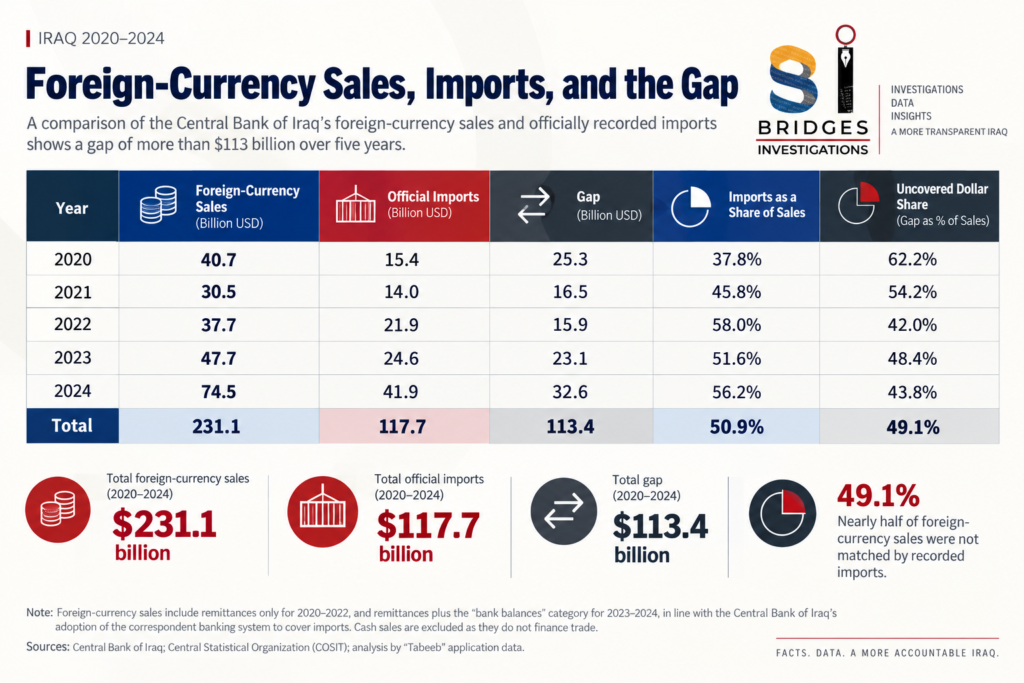
The Central Bank of Iraq’s hard-currency sales are divided into cash sales, remittances and the strengthening of banks’ balances. Because cash sales do not finance trade, external financing for 2020–2022 was calculated using remittances only. For 2023–2024, the strengthening of bank balances was added, in line with the Central Bank’s introduction of the correspondent-banking system to cover imports.
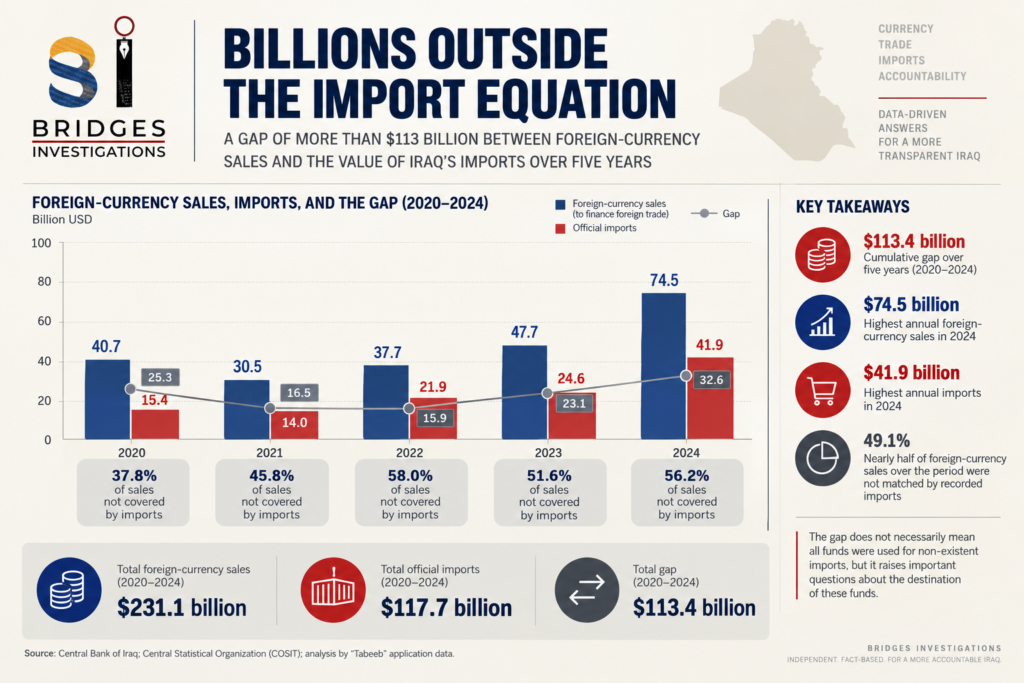
Data from the Central Bank of Iraq and the Statistics and Geographic Information Systems Authority show that external dollar transfers during 2020–2024 totalled about $231.1 billion, compared with only $117.7 billion in officially recorded imports, leaving a cumulative gap of approximately $113.4 billion.
The year 2024 recorded the highest dollar sales in the period under review: $74.5 billion, while imports rose to $41.9 billion. Although the share of dollars described here as “not commercially covered” fell from 62.2% in 2020 to 43.8% in 2024, the absolute gap remained at a record level of $32.6 billion.
Despite structural changes introduced by the Central Bank to foreign-trade financing mechanisms in 2023—including the electronic platform, which allows traders to purchase goods and then cover their dollar value through invoices, and the shift toward strengthening banks’ balances with correspondent banks—the gap jumped to about $23.1 billion that year.
Why Did the Gap Appear?
The difference between dollar sales and the value of officially recorded imports does not necessarily mean that the entire gap represents money transferred abroad to finance fictitious imports. The nature of transactions passing through the foreign-currency sales system changed during the period studied, and some dollar-denominated payments are not directly related to imports of goods.
Economic adviser and expert Adel Al-Dulaimi says the gap must be interpreted in light of changes to Iraq’s foreign-currency sales system. For years, the Central Bank relied on the traditional currency-sale window. At the beginning of 2023, it began implementing an electronic system for external transfers based on digital scrutiny of documents and invoices, in coordination with the U.S. Federal Reserve.
Al-Dulaimi says 2023 and 2024 saw tighter scrutiny of invoices and foreign transfers, which, in his assessment, changed the nature of the transactions financed through the currency-sale mechanism.
He adds that part of the gap may be linked to payments that do not appear in official merchandise-import statistics, including electronic-payment card use, travel and medical expenses, and payments by foreign companies. Such transactions increase demand for dollars without being recorded as imports of goods.
The Gap Changes From Month to Month
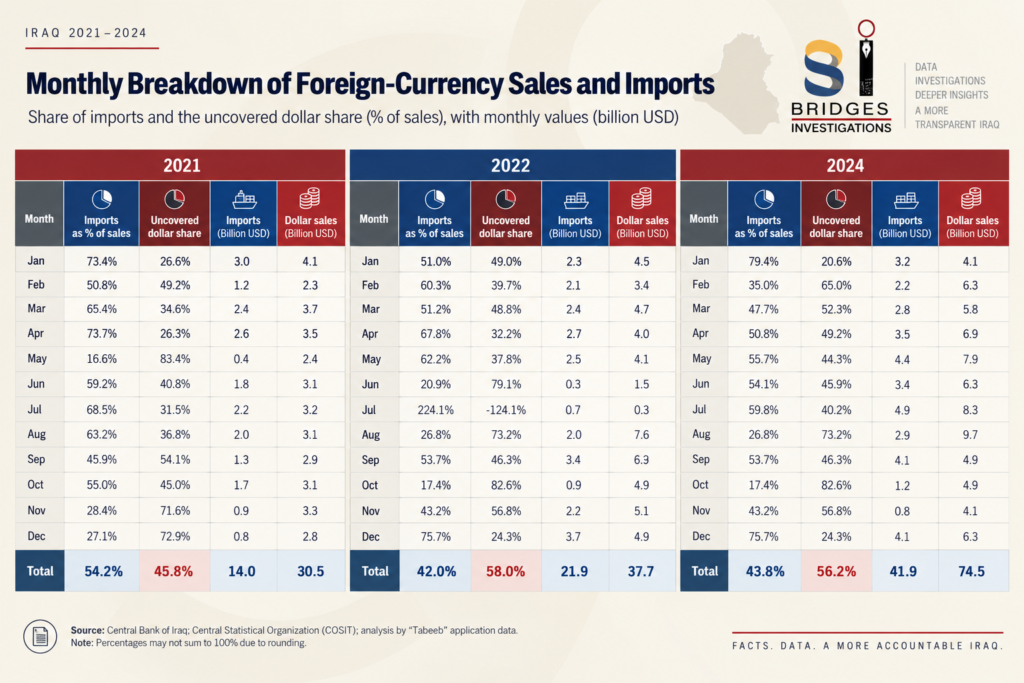
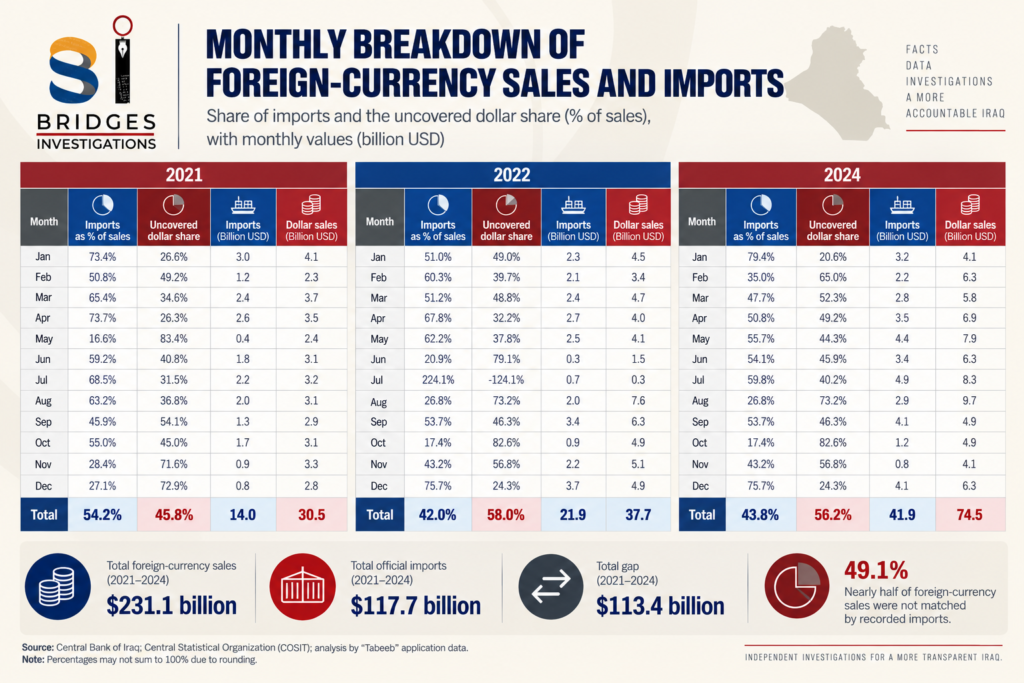
For 2023, the annual total of $47.7 billion was taken from the Central Bank’s 2024 bulletin after the value of remittances and bank-balance strengthening had been included. Monthly data for 2023 were excluded because the source did not provide monthly figures for both categories together.
These monthly variations show that the gap cannot be read as a fixed number or as direct proof of fictitious imports. The data reveal a more complex relationship between the timing of foreign-currency sales, the timing of import registration and the nature of payments passing through the dollar system. Explaining the difference therefore requires examining the movement of both money and goods.
Does the Gap Reflect Normal Commercial Activity?
Al-Dulaimi says a difference between the value of dollars sold by the Central Bank and the value of imported goods is not, by itself, evidence of a problem. Part of the demand for dollars goes to legitimate purposes that do not appear in merchandise-import data, including travel and medical expenses, service payments and external transfers.
He estimates that 70% to 90% of demand for dollars is linked to financing imports of goods, while services, foreign transfers and other expenditures account for an estimated 10% to 30% of total demand—a range he considers normal in import-dependent economies.
To illustrate the point, Al-Dulaimi gives a hypothetical example: “If the Central Bank sold $100 billion in one year, actual imports were worth $80 billion, and $20 billion went to legitimate services, transfers and expenses, that would be normal.”
But, he says, the picture changes when the gap becomes very large: “If Central Bank sales reached $100 billion while imports did not exceed $50 billion, that would warrant questions and could indicate inflated commercial invoices, currency smuggling, or transfers not linked to genuine trade.”
Al-Dulaimi stresses that comparing Central Bank sales with official import data is an important tool for identifying gaps, but it is not sufficient on its own to prove violations or money laundering. That requires further examination of commercial documents, invoice-verification mechanisms and the path of foreign transfers.
He notes that reforming the foreign-transfer system, strengthening oversight and compliance, and reducing the risks of money laundering and terrorist financing were among the issues addressed in international reports and recommendations. The Central Bank began implementing reforms in that direction through the electronic platform and the gradual shift to the correspondent-banking system.
Did the Electronic Platform Explain Part of the Gap?
At the beginning of 2023, Iraq’s dollar-sale system entered a new phase as scrutiny of foreign transfers was tightened after years of reliance on the traditional currency-sale window.
According to the Central Bank of Iraq, the electronic platform for foreign transfers began operating in early 2023 with the aim of reorganising financial transfers and moving from ex-post oversight to preventive scrutiny of dollar-sale transactions.
The Central Bank said the first phase included daily vetting of remittances by the U.S. Federal Reserve before a gradual transition to a system based on correspondent banks and an international auditing company that reviews transfers before they are executed.
At a meeting with the heads of Iraqi banks on 24 September 2023, Central Bank Governor Ali Mohsen Al-Alaq said the shift followed an agreement between the Central Bank of Iraq and the U.S. Federal Reserve. The aim, he said, was to have correspondent banks execute foreign transfers in line with global banking practice, leaving the Central Bank to supervise and regulate rather than execute the transfers itself.
Al-Alaq added that 60% of foreign transfers were being carried out through correspondent banks outside the electronic platform, and that the Central Bank was working to open transfer channels in several currencies—including the UAE dirham, euro, Indian rupee and Turkish lira—to reduce dependence on the dollar in financing foreign trade.
According to the Central Bank, that share rose during 2024. In an official statement, it said 95% of foreign transfers were being executed directly through correspondent banks, with only about 5% of transactions remaining on the platform and a plan to complete the transition before the end of the year.
The Bank also said the United Arab Emirates, Turkey, India and China account for around 70% of Iraq’s foreign trade, prompting it to establish direct transfer channels in those countries’ currencies. It said 13 Iraqi banks had already begun executing transfers under the pre-audit mechanism agreed with correspondent banks.
Although the Central Bank says these measures helped provide dollars at the official rate, reduce inflation and comply with anti-money-laundering law, the data analysed in this investigation raise a central question: did the electronic platform and correspondent-banking system succeed in curbing the financial gap?
The figures show a striking upward trajectory. When the platform was introduced in 2023, the gap did not fall. It rose from $15.9 billion in 2022 to $23.1 billion, then climbed again in 2024 to a record $32.6 billion, as the share of transfers routed through correspondent banks reached 95%.
The paradox is that the share of dollars described as “not commercially covered” fell from 62.2% in 2020 to 43.8% in 2024, yet the gap still reached its highest absolute value during the period studied because total dollar sales expanded.
These figures alone are not enough to establish a direct causal effect of the platform on the size of the gap. They do, however, leave open other explanations, including differences between when transfers are recorded and when imports are registered, the nature of payments moving through the banking system, data-calculation methodologies, and uses of dollars that do not appear in merchandise-import statistics.
The Platform’s Impact on Traders
The effects of the digital transition have not been the same for all traders.
Rashid Al-Saadi, spokesman for the Baghdad Chamber of Commerce, says the electronic platform did not reduce the number of importers. He says all traders who meet legal and banking requirements can make transfers and open letters of credit through official channels.
However, he says some traders initially had difficulty completing requirements imposed by certain banks, prompting some of them to turn temporarily to the parallel market for dollars until those problems were resolved.
Al-Saadi adds that the Baghdad Chamber of Commerce received complaints from importers who faced obstacles in using the platform and contacted the Central Bank to address the cases. He says a large number of the problems were resolved through direct coordination with the Central Bank’s management.
Did the Exchange Rate Stabilise Despite the Reforms?
Despite reforms to Iraq’s foreign-transfer system and tighter scrutiny, the gap between the official dollar rate and the parallel-market rate did not disappear. The data show that the spread widened markedly after the exchange-rate adjustment and the launch of the electronic platform, before narrowing somewhat in subsequent years, though it did not vanish.
Why Did the Dollar Remain Expensive on the Parallel Market?
Al-Dulaimi says a high volume of Central Bank dollar sales does not necessarily mean a lower parallel-market exchange rate because most of those sales do not become cash circulating in the market. Instead, they finance imports and foreign transfers through official channels.
“When the Central Bank sells $250 million or $300 million a day, most of that money goes to financing imports and foreign transfers through official channels, so it does not fully reach the cash market where the parallel exchange rate is determined,” he says.
He adds that other factors contribute to the dollar’s continued premium over the official rate, including demand outside the banking system, cash purchases that do not pass through official channels, and the effect of U.S. sanctions and measures affecting some Iraqi banks and tightening requirements for foreign transfers.
In theory, Al-Dulaimi says, if all genuine importers could obtain dollars through official channels and those channels covered all legitimate demand, the difference between the official and parallel-market rates would be extremely small—perhaps only a few dinars per dollar. But continued demand outside official channels kept the spread elevated, at times exceeding 200 dinars per dollar.
How Did the Spread Change After the Electronic Platform?
Al-Dulaimi points to exchange-rate developments in recent years, saying the difference between the official and parallel-market rates was limited before the electronic platform was introduced.
In 2022, the official dollar rate was about 1,460 dinars, while the parallel-market rate ranged between 1,470 and 1,490 dinars, a relatively limited difference.
After the electronic platform was launched and scrutiny of transfers tightened in early 2023, the official rate fell to 1,320 dinars, while the parallel-market dollar rose to between 1,500 and 1,650 dinars during 2023. In 2024, it stabilised somewhat between 1,480 and 1,530 dinars while the official rate remained 1,320.
Al-Dulaimi believes the widening spread reflects the migration of part of dollar demand to the parallel market after tighter controls on official transfers. Some dollar buyers could no longer obtain the currency through official channels and therefore turned to the cash market.
The Gap Did Not Disappear
The data show that the spread between the official and parallel-market exchange rates widened sharply in 2023. The average parallel-market rate reached 1,531 dinars to the dollar, compared with the official rate of 1,320 dinars—a difference of 211 dinars per dollar.
Despite the continued use of scrutiny mechanisms and correspondent-bank transfers, the spread persisted in 2024 and 2025, although below the 2023 peak. The average parallel-market rate was 1,499 dinars in 2024 and 1,444 dinars in 2025, against an unchanged official rate of 1,320 dinars.
These figures indicate that the reforms did not eliminate the gap between the two rates. Their implementation coincided with a sharp widening in 2023, followed by a partial decline, but the gap remained in subsequent years.
What Happens When a Gap Appears?
Legal expert and adviser Mohammed Al-Rubaie says that, from a legal standpoint, a gap between the value of dollars sold by the Central Bank of Iraq and the value of officially recorded imports is not in itself evidence that a crime has been committed. It is, however, an indicator that warrants scrutiny and verification by financial and oversight bodies.
Al-Rubaie says that when discrepancies are detected between foreign transfers and import values, the Central Bank verifies whether the transfers match commercial documentation, including invoices, shipping documents, customs declarations and tax records, to ensure that transferred funds were used to import goods that actually entered Iraq.
He says these documents are the central link in verifying the integrity of transfers because they make it possible to match the value of transferred funds with the value of imported goods and customs-clearance procedures.
Al-Rubaie says that forged invoices, inflated import values or transfers unsupported by genuine commercial activity may lead to a referral to the competent judicial authorities, including the Integrity and Money Laundering Investigation Court, while the relevant executive authorities pursue the investigative aspects under the Anti-Money Laundering Law.
From the Central Bank’s Window to the Market
As the investigation’s journey through data, documents and testimony comes to an end, Haider’s story returns to the foreground as a reflection of the reality experienced by thousands of traders in Iraq.
Every morning, Haider gathers his sales proceeds in Iraqi dinars and goes to the exchange market to buy the dollars he needs to keep his business running. For him, exchange rates are not figures in tables or economic indicators. They are a daily cost that determines his profit margin, his ability to remain in business and the prices at which goods reach consumers.
But the investigation shows that Haider’s experience is only the final link in a much longer chain—one that begins with the Central Bank’s foreign-currency sales system, passes through banks, transfer companies, importers and commercial documents, and ends in local markets.
Over five years, official data show that the Central Bank of Iraq sold about $231.1 billion, while officially recorded imports were worth $117.7 billion, leaving a cumulative gap of $113.4 billion.
The gap does not, by itself, mean that the amount represents illicit transfers or fictitious imports. Experts interviewed for this investigation say part of it may be linked to legitimate transfers, service expenditure, travel and other payments that do not appear in merchandise-import data. At the same time, the scale of the difference raises questions about how closely the movement of money matches the movement of goods, and about the ability of oversight systems to trace funds and verify the documents submitted to obtain dollars.
Official documents show that at the beginning of 2023 the Central Bank began reforming the foreign-transfer system, introducing the electronic platform and then gradually shifting to correspondent banks while tightening scrutiny in an effort to strengthen compliance with international standards and reduce the risks of money laundering and terrorist financing.
Despite those measures, fundamental questions remain without definitive answers: how much of the gap can be explained by legitimate transfers? How much results from differences in timing or data-calculation methodologies? And are current procedures sufficient to ensure that every dollar leaving through official channels can be traced to genuine commercial activity and verifiable documentation?
As he leaves the exchange market carrying the dollars he needs, Haider says: “We buy dollars so that we can work.”
But the question posed by this investigation is not why Haider buys dollars. It is what happens after that: where does the full flow of the billions of dollars sold by the Central Bank every year ultimately end up, and to what extent do official data capture that journey?
A complete answer depends on greater transparency, access to data, and stronger oversight. Confidence in the economy is built not merely on the availability of dollars. Still, on clarity about the path they take—from the moment they leave official channels until they are converted into goods and services reaching the Iraqi market.
Ultimately, the data examined in this investigation show a gap exceeding $113 billion between figures for dollar sales from 2020 to 2024 for import-related purposes—through currency-auction remittances and the electronic platform—and import and transfer figures for the same five-year period, including the strengthening of banks’ balances.
Whatever its size, a discrepancy between dollar sales and imports does not acquire legal significance merely because it appears in the data. A definitive assessment requires examining commercial documents, tracing the chain of financial transfers, and verifying that the goods entered the country or that the services for which the funds were transferred were actually delivered. Documents and transaction-level data—not the numerical gap alone—are therefore the basis for determining whether transactions are legitimate or warrant investigation.
The investigation contacted the Central Bank of Iraq’s media department more than once. The Bank did not provide a direct answer regarding the gap and did not challenge the figures. Instead, it referred the investigation to a general statement issued in March 2025 on the mechanism for publishing foreign-currency sales data, as well as to the 2021 Financial Stability Report and the table of key financial indicators. Those materials do not contain data on currency-window sales or the value of imports during the period under review.
In that March 2025 statement, the Central Bank said it had moved to a monthly report containing details of foreign transfers and the main commodities and countries involved. It stressed that “the strengthening of banks’ balances does not reflect daily sales to bank customers until the transactions are actually completed.”
This investigation is conducted in collaboration with Aaber and Bridges Investigations.