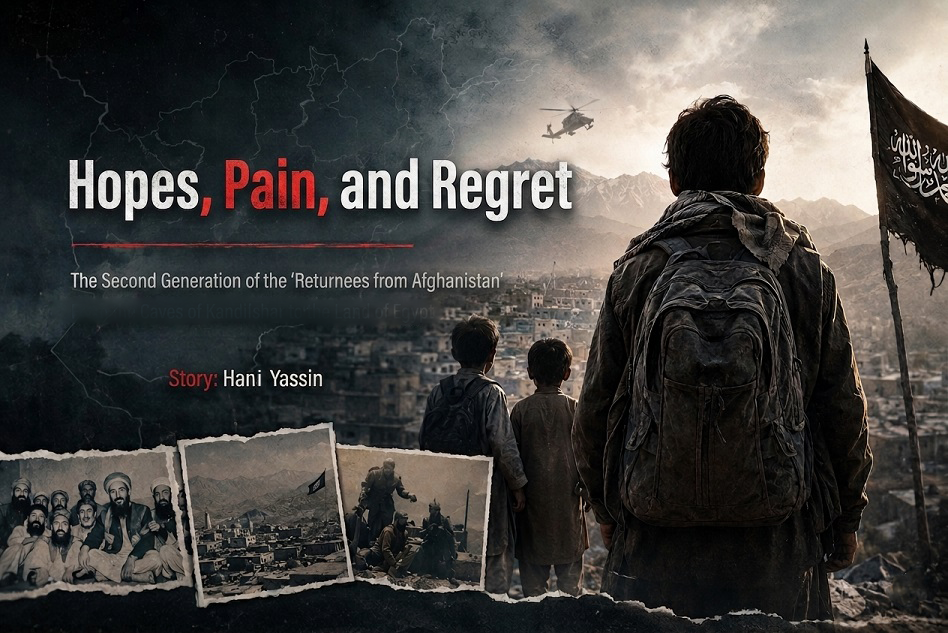
Anas was four and a half years old when he was taken from his home without being told where he was going. More than two decades later, his memories offer a rare glimpse into a largely overlooked generation: the children of the men who travelled to Afghanistan to fight—the sons and daughters who inherited their parents’ wars before they were old enough to understand them.
With the outbreak of the Afghan–Soviet War in 1978—although some historical accounts trace the roots of the conflict back to 1973—a wave of Arab volunteers began making their way to what was then widely described as the “land of jihad.” Encouraged by official support from several Arab governments and aided by facilitated travel routes through Pakistan into Afghanistan, thousands of Arabs, particularly members of Islamist movements, travelled there to support what were then known as the “Afghan mujahideen.”
Numerous Egyptian and non-Egyptian groups sent members to Afghanistan, including the Muslim Brotherhood, Al-Gama’a Al-Islamiyya, Egyptian Islamic Jihad, and individuals who were not formally affiliated with any of these organisations. Some were killed in the conflict, others remained in Afghanistan, while a smaller number eventually returned to Egypt, only to find themselves caught up in what later became known as the “Returnees from Afghanistan” case.
Amid these developments emerged a generation commonly referred to as the “Arab Afghans” — or what I describe as the “second generation of the Returnees from Afghanistan.” By this, I mean those who travelled to Afghanistan with their families at a young age, or those who were born there and grew up amid the conflict. They lived through an experience over which they had no control, finding themselves participants in a story and a cause they had never chosen.
Public attention has traditionally focused on the prominent leaders whose names feature on international and domestic security watchlists, dominate newspaper headlines, and serve as the primary reference points for researchers and analysts assessing the Afghan experience and its legacy.
Dr Amr Abdel Moneim, a researcher specialising in radical movements, says that while the wives and children of those who travelled to Afghanistan have featured in academic research, attention has overwhelmingly focused on the movements’ leaders and active members.
The children, he argues, raise a different question: to what extent can ideology and affiliation be inherited?
“Many of the children of those who returned from Afghanistan or other conflict zones no longer share their fathers’ ideology,” Abdel Moneim says. “Even within the same family, one child may embrace those ideas while two others reject them.”
Far less attention, however, has been paid to another category: those who were not actors in these events but rather subjects of them. They were individuals with little agency over their circumstances, thrust into the heart of a conflict not by choice, but because they were the sons and daughters of men who had decided to travel and join armed struggles in Afghanistan—or later in other conflict zones such as Chechnya, Bosnia and Herzegovina, and beyond.
Years later, members of this generation would find themselves returning—sometimes by choice, sometimes out of necessity—to homelands they had known only through the stories they had heard.
It was only then that they began to look back on the experience and confront the many questions surrounding the lives they had led there: How had they grown up? What kind of education had they received? What had everyday life and childhood looked like? What did they remember of their days of joy and nights of sorrow, of childhood games alongside military training? How had they endured life under bombardment—the terrifying moments beneath the roar of aircraft and the thunder of artillery? What did fear, deprivation and uncertainty mean to a child growing up in such circumstances?
There were other questions, too: about their relationships with children from other countries; about Osama bin Laden and what, if anything, he represented in their childhood world; and about the country they were now returning to, a homeland many of them had never truly known.
And perhaps the most difficult question of all: How did they see their own country? Had it wronged them—or were they the ones it regarded as having done wrong?
Children of Kandahar
Anas (pseudonym) was born in Sudan in 1995, into a world shaped by decisions he was too young to understand, let alone make. At the time, Osama bin Laden, al-Qaeda leader, was living in the country, surrounded by a community of Arab families whose lives would soon be uprooted again. Anas’s family was one of them. According to his account, around 23 other families were also living in Sudan at the time, together numbering more than 500 people.
The families remained there for nearly a year, until the United States pressed then-Sudanese President Omar al-Bashir to expel bin Laden and those associated with him. By that point, bin Laden had established a number of business ventures in Sudan, reportedly worth around $6 million, all of which he left behind when he departed Khartoum.
The family of “Anas”—a pseudonym used to protect the identity of the man at the centre of this account—was among those who subsequently left Sudan. They were flown aboard Sudanese aircraft directly to Afghanistan, where they were received by Mawlawi Yunus Khalis, leader of an Afghan Islamist faction and one of the prominent figures in the power struggle that followed the Soviet withdrawal. Khalis later distanced himself from the internecine conflict and turned his attention to the affairs of his tribe.
According to Anas, Khalis and bin Laden had developed a close relationship. Khalis regarded bin Laden not only as an ally but also as a businessman and investor whose wealth and experience could help revive Afghanistan’s devastated economy. The country had been exhausted by years of war—first by the conflict with the Soviet Union and then by the bitter struggle for power among rival Afghan factions.
The Arabs’ Other Country
In the years leading up to this period, Afghanistan had been engulfed in a prolonged struggle among factions that had once fought together against Soviet forces. The conflict continued between forces loyal to Burhanuddin Rabbani and his military commander, Ahmad Shah Massoud, on one side, and the Taliban, led by Mullah Mohammed Omar, on the other. Gulbuddin Hekmatyar had withdrawn from the fighting, while several smaller and less powerful factions had been defeated.
It was against this backdrop, Anas recalls, that Osama bin Laden and the Arab fighters around him—particularly the Egyptians—decided to distance themselves from what they regarded as an internecine conflict. Anas recalls their position at the time: “We drove the Soviet Union out of Afghanistan. The war was over.”
According to Anas, life changed dramatically after Massoud’s assassination.
“Before, we used to travel discreetly in cars with tinted windows. Afterwards, those same cars became a symbol of power,” he recalls. “People began pointing to us as the ones who had helped bring an end to the fighting among Afghanistan’s factions.”
Anas says that many Afghans welcomed Massoud’s death, claiming that even some of his own followers were pleased. Others, he says, submitted to the Taliban as the movement consolidated its control over the country. In his recollection, the Taliban increasingly came to be regarded as the country’s governing authority and as representing an interpretation of Islam that resonated with much of the population.
Anas continues his account: “As soon as the Arabs returned to Afghanistan, they began setting up training camps and establishing schools for their children. They lived largely separate lives from the Afghans. We had our own emir, Osama bin Laden, while the Afghans were governed by Mullah Mohammed Omar.”
Anas’s family settled in Kabul. With the cost of living extremely low at the time, he recalls, his father rented an entire three-storey hotel exclusively for the family. They remained there for an extended period, turning the building into both a home and a communal space. During Ramadan, they held Taraweeh prayers there, while the hall on the ground floor was used for Eid celebrations, ritual animal slaughter, and other family and religious gatherings.
Life there, however, was not without danger. Anas recalls one incident in particular:
“We survived an assassination attempt. One night, someone left a black bag in a rubbish bin beneath the hotel where we were staying. That evening, the brothers had gathered in the downstairs hall to celebrate Eid. Shortly after they left, the bomb exploded. The blast tore the hotel’s main door completely off and caused damage to the building.”
Anas believes the attacker had expected the explosives to be powerful enough to destroy the entire building. “He miscalculated,” he says. “No one was hurt.”
He claims that the alleged attacker was later captured and found to have received funding from an American source, under an arrangement that would have paid him $90 if the bombing killed at least ten of the men staying at the hotel. Anas further recalls that, following the attack, the Taliban authorities prohibited the use of black rubbish bags, requiring residents to use white bags instead.
Kandahar, Capital of the Arabs
Kandahar was the Anas family’s second home in Afghanistan. Anas describes the city as the de facto capital of the Arab fighters, since it housed many of the organisation’s training camps and served as a reception point where newly arrived “Arab mujahideen” were accommodated and prepared for combat.
It was there, Anas recalls, that Osama bin Laden chose a heavily fortified residence on a mountainside. The compound was exceptionally large and tightly guarded. Red Crescent vehicles, he says, could often be seen waiting outside for permission to enter, their occupants apparently seeking to understand what bin Laden was doing inside. “They believed he was planning something dangerous,” Anas recalls.
Anas’s father was a wealthy man who used his money both to support his family and, according to his son, to finance the organisation. His wealth came largely from an extensive honey and gold trading business operating through Saudi Arabia and Sudan, supported by a network of associates. That financial position enabled him to rent a substantial villa in Kandahar, surrounded by a high perimeter wall.
“We lived in a villa on the outskirts of the city, enclosed by a wall,” Anas recalls. “Our neighbour was a farmer who grew crops and raised cattle, and we relied on him for many of the dairy and other livestock products we needed. Our life was stable. My father would leave in the morning like any ordinary employee and return in the evening.”
Behind that outwardly ordinary routine, however, Anas says his father held a senior position within the organisation.
“He would go to the camps and oversee the fighting against the remaining forces loyal to Massoud,” Anas says. “He also supervised the country’s borders with neighbouring states and was responsible for what amounted to the organisation’s intelligence apparatus.”
Despite the seniority of his position and the responsibilities entrusted to him, Anas says his father had no dedicated security detail and generally relied on his personal weapon for protection. In his later years, that role increasingly fell to his two sons. One was 19 at the time; the other was Anas, then 16. Both, Anas says, had undergone several specialised protection and security courses, which they completed before taking on responsibility for guarding their father.
When a Satellite Receiver Was a Luxury
Life in Afghanistan was rudimentary, and living conditions for the Arab families were often difficult. Many relied on solar power for lighting, to the extent that homes occupied by Arab families could sometimes be identified by their solar panels. Among local Afghans, electricity was rarely available or used. Most roads were unpaved, women baked bread by hand each day, and household appliances such as washing machines were largely absent.
Anas’s family was relatively fortunate: they owned a television and a satellite receiver, possessions that were far from commonplace at the time.
“Compared with the local population, we lived a very privileged life,” Anas recalls. “But compared with life elsewhere, there was very little in the way of comfort or luxury. It wasn’t because we couldn’t afford those things; they simply weren’t available.”
Childhood Under Military Discipline
Education there was not organised around clearly defined stages, partly because the number of students was relatively small and everyday survival often took precedence over formal schooling. Committees were responsible for supporting families that had lost their breadwinners, and young men were frequently called upon to help with such responsibilities.
According to Anas, once boys had progressed beyond the equivalent of middle school, they were effectively regarded as young men—old enough to carry a weapon, drive, and assume adult responsibilities. They were given considerable freedom over their daily lives and were not necessarily required to follow a programme prescribed by the organisation. Yet, Anas says, the environment around them meant that many gravitated towards these roles voluntarily.
Despite holding a senior position within the organisation, Anas says his father did not force his children down a particular path.
“He was open-minded,” Anas recalls. “He wouldn’t stop us from doing something we wanted to do, nor would he push us towards a particular course of action. He dealt with us naturally and gave us space to make our own choices.”
Friday in Kandahar
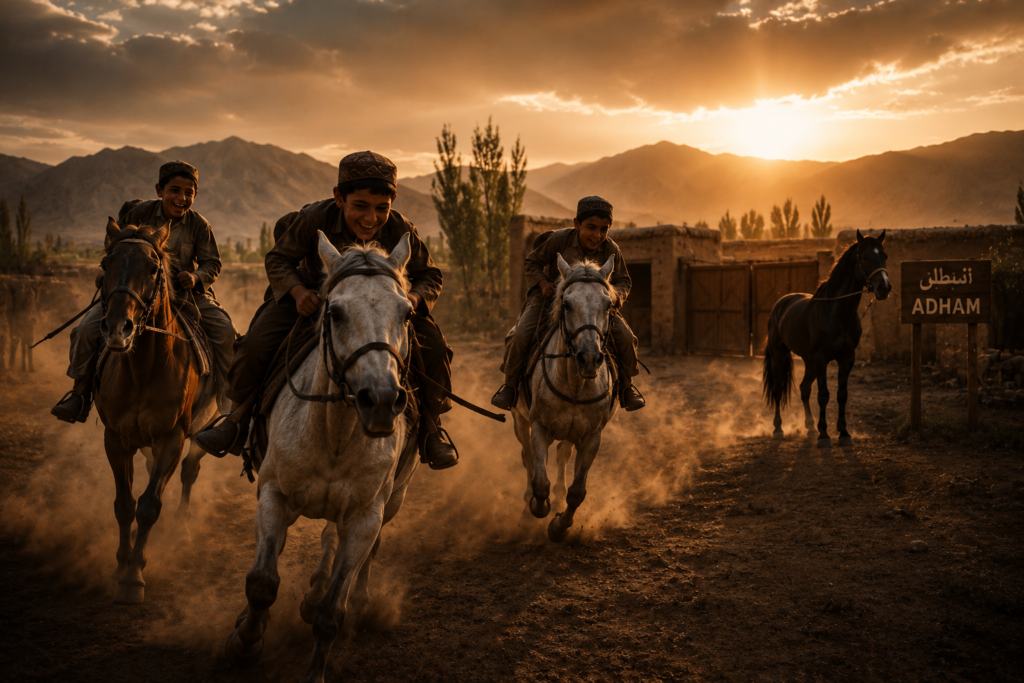
Fridays were their day of recreation. They would head to an area near the airport, where vast stretches of open land provided space to play, relax, and ride horses. In the garden of the family home, Anas’s father grew molokhia, the leafy green vegetable central to one of Egypt’s most familiar dishes. Every Friday, his mother would pick the leaves and prepare them in the Egyptian style for the family’s day off.
Friday also became a day for Egyptian food: ful, taameya, and other traditional dishes his parents loved. For Anas, however, these foods were unfamiliar. Having been born and raised outside Egypt, he had little direct connection to the country’s cuisine. His Egyptian mother had herself lived in several countries—including Yemen, Saudi Arabia, Sudan and Iran—and regularly cooked dishes she had learned during those years.
On Fridays, they would also visit what Anas calls the “Brothers’ Theatre,” where performances and Islamic nasheeds, or devotional songs, were staged.
Anas and the other boys would sometimes slip into Osama bin Laden’s horse farm, take the horses without permission, and ride them. At one point, he recalls, they took as many as nine horses. There was one animal, however, that they did not dare approach: bin Laden’s own horse, which appeared with him in several photographs.
“He called him Adham,” Anas recalls. “No one could get close to him or ride him except bin Laden. He was fierce and powerful.”
According to Anas, bin Laden had brought the horse with him from Saudi Arabia and kept around 23 horses in total for himself and his children.
The children found entertainment in things that reflected the world in which they were growing up. Anas recalls that he and boys his age would make whistling sounds using spent ammunition casings. Cartoons held little appeal for them. They were still children, but they had already begun to see themselves as adults.
Al-Farouq: When Childhood Entered the Camp
Anas’s story stretches across years and is filled with episodes that reveal a side of the “Arab Afghan” experience that has received far less attention. It is often viewed almost exclusively through the prism of war and armed conflict, obscuring the human and social dimensions of the lives that unfolded alongside it—with all their contradictions.
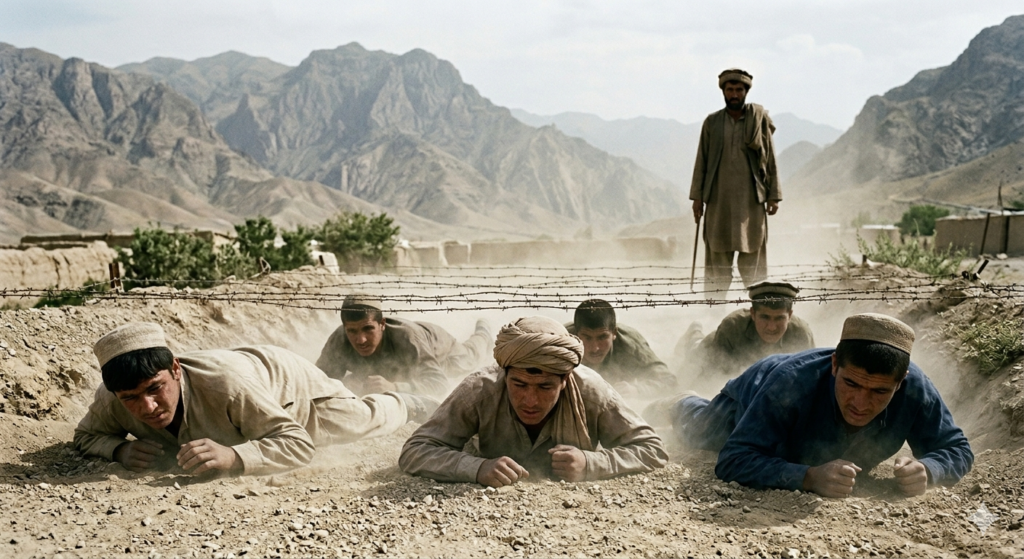
Life for Anas in the hills around Kandahar was no exception. Alongside the ordinary rhythms of family and childhood was something altogether different: intensive physical and military training. Some of it, he recalls, was exceptionally harsh—training imposed on children so young that neither their bodies nor their minds could reasonably have been prepared for its demands.
Anas remembers one of the instructors who supervised the camps: a Bengali martial-arts trainer who, he says, had been living in Turkey. He describes him as an experienced kung fu instructor, courteous in the way he spoke and treated the children, but uncompromising when it came to discipline.
“The first camp I attended, I was four and a half years old,” Anas recalls. “It was Al-Farouq camp. They cleared out the people who were already there and brought us in. We arrived on Thursday and stayed until Saturday. They took us from our homes without telling us where we were going. We were given military uniforms made to fit children our age. The oldest among us was nine.”
After the afternoon prayer, he says, the children were taken on a march through the mountains and hills that continued until evening.
“I could see my father at the camp, and then suddenly he disappeared. From that point on, we were treated entirely like soldiers. Anyone who cried was punished by being denied food. They woke us before the dawn call to prayer and made us run up and down the mountain for two and a half hours. If one of us fell, they left him behind. He would cry, then get back up and try to catch the others. There was no other choice.”
When they returned to camp, food was placed before them, but the children were forbidden to touch it until the military instructor gave permission.
“We had three meals a day. It was dry bread broken into small pieces and milk. Nobody dared complain about the food.”
On one occasion, Anas recalls, one of the children did complain. The instructor overheard him and punished him by withholding both breakfast and lunch. The boy eventually became so overwhelmed by hunger that he broke down crying, at which point, Anas says, they finally gave him something to eat.
The training at Al-Farouq included crawling, negotiating and breaching obstacles, jumping exercises and firearms practice. During shooting drills, an instructor would help the children hold the weapon to control its recoil. The instructor would steady the firearm, direct the child’s attention towards the target and then order him to pull the trigger. Those who hit their targets were praised and rewarded.
The children were also taught martial arts by the Bengali instructor.
Like the other children, Anas completed the three-day training camp and returned home. He remembers what happened next vividly.
“The three days passed and I didn’t cry,” he tells me. “I was a very withdrawn child. When I came home, my mother took me to bathe and saw the wounds across my back from crawling beneath the barbed wire.”
Distressed by what she saw, his mother went to tell his father, her eyes filling with tears. His father, Anas recalls, laughed, then left the house. In doing so, however, he forgot three radio sets he had been carrying. His call sign over the radio was “Qutaybah.”
“After he left, we took the radios,” Anas says. “Whenever one of the brothers called asking for my father, I would insult him because of what had happened to me at the training camp.”
None of the men, he recalls, dared come into the family home because of his father’s senior position. By the time his father returned, however, they had told him what Anas had done.
“He took my brother and me to see them,” Anas says, “and made us apologise for what we had done.”
International child-protection standards regard the recruitment or use of anyone under 18 by armed forces or armed groups as a grave violation of children’s rights. The experience Anas describes also illustrates a broader problem documented across conflicts: children can be drawn into military environments long before they are capable of understanding the ideology, loyalties or consequences surrounding them.
Growing Up Inside Al-Qaeda’s World
Because Anas’s father was close to Osama bin Laden, Anas says he encountered the al-Qaeda leader on numerous occasions. One meeting, however, remains particularly vivid in his memory.
“We were at the camp, and Omar, the son of Sheikh Shaker—one of the instructors—was hitting me while I was sitting beside my father. I wasn’t hitting him back. Sheikh Osama bin Laden happened to see what was going on. He asked Omar why he was hitting me and told us to get up and wrestle.”
The two boys stepped into the centre of the training ring.
“He was older than me, but I threw him to the ground and hit him hard enough to split his head open. He started bleeding. The sheikh didn’t punish me or reprimand me. He just told me to sit beside him.”
The confrontation did not end there. “When we left,” Anas recalls, “I found the boy waiting for me outside. He started throwing stones at me.”
The “Arab Afghans” built lives that extended beyond camps and combat. Marriage—and, in many cases, polygamy—was another part of the social structure that developed around their community. According to Anas, getting married was neither complicated nor particularly expensive. Marriages could be arranged quickly, with the organisation often covering the costs.
Members worked within the organisation, which in turn supported them and their families financially. Each member and family received a monthly allowance, Anas says, with payments increasing according to the number of children because larger families had greater needs. During religious holidays and other occasions, families were also given money for the udhiyah, the ritual sacrifice—an amount he recalls as sufficient to purchase a calf rather than a sheep.
For a man wishing to marry, finding a prospective bride usually depended on relatives, friends or other members of the community. Social interaction between unrelated men and women was heavily restricted, and women generally did not go to markets. Local Afghan women wore the niqab, while Arab women who came from religious traditions that did not ordinarily require it were nevertheless expected to cover their faces in accordance with the rules imposed by the authorities.
Anas recalls that there was no standardised dowry. Gold was optional and depended on what the couple and their families agreed upon, sometimes accompanied by a small number of gifts. The process, he says, was deliberately kept simple.
In the increasingly dangerous environment that followed the US-led intervention, one consideration became especially important: whether a prospective husband was capable of protecting his wife. A man could approach a family and ask for a woman’s hand in marriage. The proposal might be accepted or rejected; if rejected, he could approach another family. According to Anas, acceptance was common provided there were no significant concerns about the prospective husband.
He remembers one Syrian man, whom he identifies as Hassan, as an illustration of how quickly marriages could take place.
“One of the brothers, Hassan, came to us from Syria,” Anas recalls. “As soon as he arrived in Afghanistan, he married. By the end of the month, he had married a second wife.”
Divorce, he says, could be similarly straightforward and carried relatively little social stigma within the community. Divorced and widowed women could remarry, sometimes repeatedly. Anas remembers one woman whose seven husbands, he says, had all died.
She worked in the organisation’s administrative section, an area in which Anas’s father also held responsibility, alongside a department dealing with social affairs. These structures, according to Anas, played an important role in managing the everyday needs of Arab families.
Women working in the administrative section would visit families in their homes to assess what they lacked and what assistance they required. Through these visits, they also knew which households included unmarried women or girls of marriageable age. When a man expressed an interest in marrying, the organisation therefore had an informal network through which it could identify unmarried or widowed women within the community.
According to Anas, marriages were not necessarily accompanied by a formal written contract. In his account, the marriage was considered established through the offer and acceptance of marriage in the presence of witnesses, followed by its public acknowledgement within the community.
When Death Became Ordinary
The days passed with their share of joy and sorrow. Moments of celebration were followed by grief; births by death and killing. Such was the rhythm of life in a country at war, particularly after the US-led intervention. Death became so commonplace, Anas recalls, that scarcely a day passed without one or more people being killed. Over time, even mourning began to lose its meaning. How could they grieve for one death when another came the following day?
Anas remembers his father returning home almost every day with bloodstains on his clothes. His wife would fear that he had been wounded, only for him to reassure her that the blood was not his, but that of men who had been killed that day and whose bodies he had helped bury.
“We didn’t allow ourselves to grieve because every day we were saying goodbye to someone,” Anas recalls. “If we had mourned every death, we would have been psychologically destroyed. A lot of the time, we simply stayed silent. We couldn’t really comprehend what was happening around us; we were still quite young.”
The burden was compounded, he says, by his father’s reluctance to speak about what he was witnessing or to show emotion.
“My father didn’t talk much, and he never really expressed his feelings. He would simply remain silent.”
That, Anas recalls, was how they learned to live with death in a place where it had become part of everyday life.
The Day Childhood Ended
No one among the local Afghan population, Anas says, knew in advance what was going to happen on September 11. Families associated with the organisation, as well as most of its members, learned of the attacks from television. According to his account, only Osama bin Laden and those directly involved in overseeing the operation had prior knowledge. Anas also recalls that many of bin Laden’s advisers had opposed attacking the United States.
The attacks took place on September 11, and American threats of retaliation soon followed. Anas remembers the atmosphere inside his own home that day.
“We knew nothing about the operation. We were celebrating an occasion that day, but my father ordered the gathering to end at sunset, much earlier than usual. Throughout the celebration, he seemed uneasy. There was something strange about his expression. He was extremely anxious.”
In the period that followed, Anas recalls American aircraft dropping leaflets over areas where they lived. Rumours spread that the papers had been contaminated with anthrax. Anyone who handled them, he says, was taken for medical tests.
“Eventually, they discovered that it wasn’t true,” he recalls. “We were told that the powder on the paper was there to preserve the printing from exposure to the sun because the leaflets were being dropped from aircraft.”
According to Anas, the leaflets carried a message calling for Osama bin Laden to be handed over in exchange for American support for Afghanistan. The message, he remembers, appeared in Arabic, English and Pashto.
“We were children, so we would collect the leaflets and play with them,” he says. “But even as children, we could sense from everything happening around us that there was danger and that we were no longer safe.”
Life across Afghanistan’s plains and valleys had long shifted between hardship and periods of relative calm. After September 11, however, Anas remembers the situation deteriorating rapidly. Daily life became increasingly defined by aerial bombardment, fighting on the ground, and a mounting death toll.
For Anas, his family and the other Arab families around them, the period was marked by fear, vigilance and uncertainty. They could do little but wait, unsure of what the coming days would bring.
The change became tangible one evening when Anas’s father returned home unusually early. Moving quickly through the house, he placed strips of adhesive tape across every window, running them horizontally and vertically over the glass. He then took his weapon and radio and hurried away to join the organisation’s leadership as they prepared for what was coming.
The reason for the tape was practical: if a nearby explosion shattered the windows, the adhesive could help hold fragments of glass together and reduce the risk of shards flying through the rooms and injuring those inside.
News reports on television and radio warned that air strikes could begin around midnight. Anas remembers the hours leading up to that moment.
Inside the Bunker
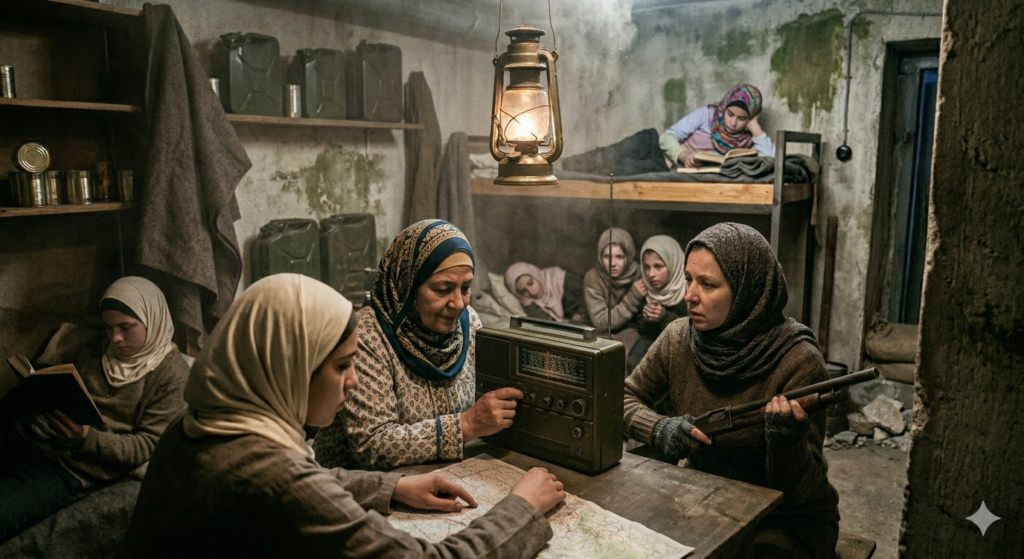
“Before my father left, carrying his weapon and radio, he told my mother to take us downstairs,” Anas recalls. “He had built an entire underground level beneath the house as a shelter, reinforced with military-grade concrete, to protect us during explosions and to prevent the house from collapsing on top of us if it was bombed.”
The shelter, he says, had been constructed in the shape of the letter S. Its unusual design was intended to preserve an escape route if part of the structure collapsed, reducing the risk that those sheltering inside would be trapped beneath the rubble.
The shelter was spacious inside. Only trusted members of the organisation were allowed to excavate and prepare such structures. According to Anas, the organisation had a dedicated unit responsible for secretly digging shelters and trenches beneath or around individual homes.
“We went downstairs with a radio so we could follow the news,” Anas recalls. “My mother stayed beside us carrying a weapon. My father had taught her how to use it. Most families would go to sleep immediately after the evening prayer, but that night we remained awake until eleven. Then my father returned. Outside, the dogs were barking furiously, as though they could sense that something unusual was about to happen.”
Anas still remembers the scene in striking detail.
“My father sat upstairs and told my mother to bring us back up because it was extremely humid inside the shelter and there was no ventilation. He told her, ‘Come upstairs and whatever happens, happens. It’s better than suffocating down there.’”
The family gathered on the roof of the house and remained awake. Anas’s sister was ill with a fever that night, and their mother repeatedly went to check on her before returning to the others.
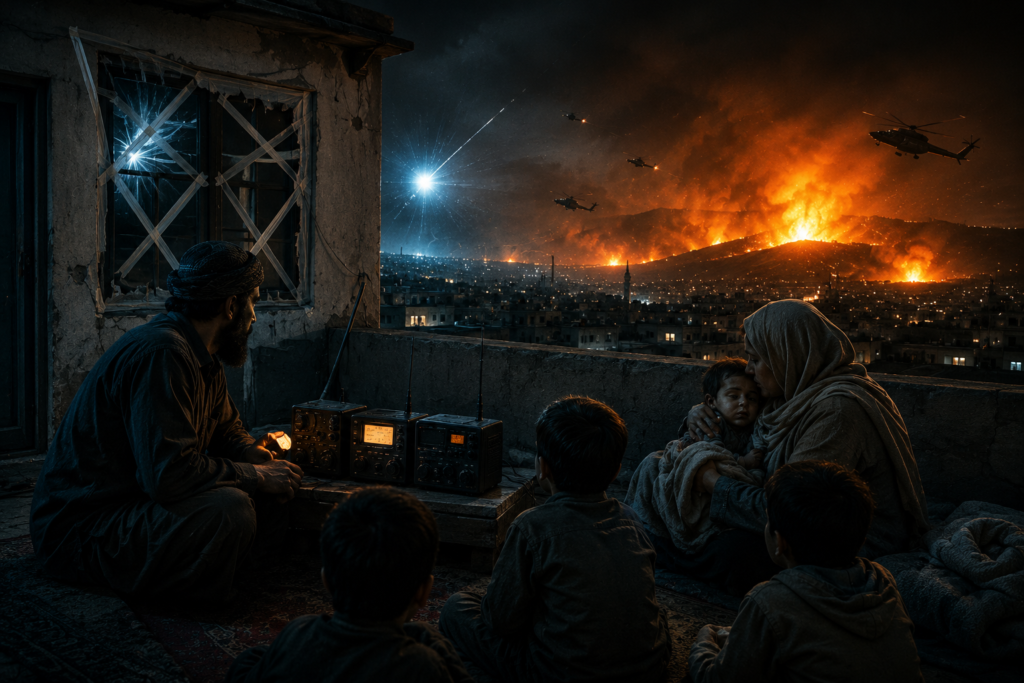
“My father sat beneath a large streetlight, its light shining behind him,” Anas recalls. “He was sitting with one leg crossed over the other, shaking his foot as he always did. Beside him were three radios through which he was receiving information in coded phrases.”
One expression Anas remembers was: “Where did you take the flour?” In their coded language, he says, “flour” referred to explosives. Other seemingly ordinary phrases were used in much the same way.
As a senior figure in the organisation and a potential target, Anas says his father should have switched off his radios to reduce the risk of his location being detected. He did not. Instead, he sat some distance away from the rest of the family.
“At one point, my mother tried to move closer to him,” Anas says. “But he told her to stay where she was and not come near him. He was afraid he might be under surveillance and that she could be harmed if he were targeted.”
Then the countdown to the airstrikes began.
The Roof Before Midnight
The countdown began, but Anas’s father remained calm, showing no outward sign of anxiety. Then, at the expected hour of the attack, night suddenly seemed to turn into day.
“The sky lit up strangely,” Anas recalls. “First there was an intense blue light, then a deep red glow. That was when we knew the bombing had begun.”
From a distance, he says, the flash arrived before the sound. There was a sense of fire approaching, followed by an orange glow that gradually faded. Then came the sound—and finally the shockwave. The force of the explosion shattered roughly half the windows in the family home. Anas and his siblings moved closer to their father, reciting prayers and asking God for forgiveness.
Less than fifteen seconds later, a second strike hit a neighbouring house belonging to an Afghan man. Anas believes his family’s home may have been the intended target and that the strike had missed.
“My father remained seated and didn’t move,” Anas recalls. “The radios beside him began transmitting coded messages. He understood what they meant, picked up his jacket and put it on. It was obvious that something serious had happened. You could see it in his eyes and in how quickly he left.”
Before leaving, his father told Anas’s mother that if anything happened, she should take the children down into the shelter.
“We didn’t see him again until around noon the following day,” Anas says. “When he came back, his clothes were covered in blood. He didn’t speak. He didn’t eat or drink. He simply went to sleep. Two hours later, he woke up, changed his clothes and left again. He returned at around noon the next day.”
His father later told the family that he and other members of the organisation had been recovering and burying the bodies of those killed in the strikes—both members of the group and local residents. According to Anas’s recollection, they were burying close to 200 people a day. Many of the dead, he says, were his father’s friends or men who had been staying at training camps, which, along with weapons depots, were among the first sites targeted.
Anas says the Arab fighters at the time believed that Afghan informants were providing intelligence to the Americans in exchange for money. “They would do anything for dollars,” he recalls.
For three days, Anas and his family remained confined to their home, neither going outside nor speaking to anyone. On the fourth day, when they finally emerged, they discovered a number “3” marked on the house. According to Anas, such markings were believed to have been left by informants to identify buildings designated for attack.
His mother immediately contacted his father by radio. He arrived quickly by car and evacuated the family. He also took their neighbours with them because the neighbours’ father was away at a camp.
They were taken first to another camp whose role had been to secure the airport. By then, however, it had been evacuated of fighters because of fears that it too would be bombed.
From there, the families moved to the outskirts of the city, where a member of the organisation whom Anas identifies as Saeed lived among farmland. Four families crowded into his small house, which consisted of just two rooms and a bathroom, surrounded by open land.
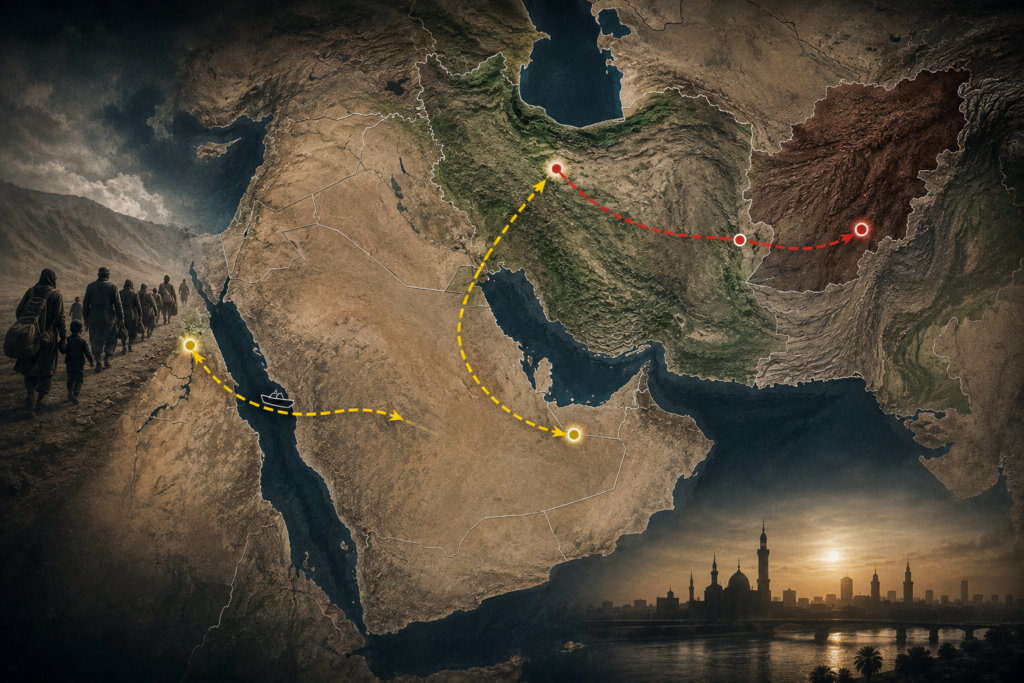
They remained there for some time. Eventually, as the US-led military offensive drew closer, the organisation’s leadership decided that the families should be moved out of Afghanistan and sent to Iran, fearing that they could be killed in American air strikes or captured as ground forces advanced.
The Road to Tehran
Anas continues his account. By 2003, he says, his father had begun making arrangements for the family to leave Afghanistan for Iran.
“My father started arranging our journey to Iran,” Anas recalls. “By then, countries had closed their doors to their own nationals who had been in Afghanistan, and we believed that anyone detained in another country would be sent directly to Guantánamo. Iran was the only option left to us.”
According to Anas, his father acted as a liaison between the Arab members of the organisation and the Iranian authorities, and approached them formally about the families’ arrival.
“They agreed to let us enter and opened the border to us without visas,” he says. “But the condition was that we had to reach the border clandestinely, without their involvement, and at our own risk.”
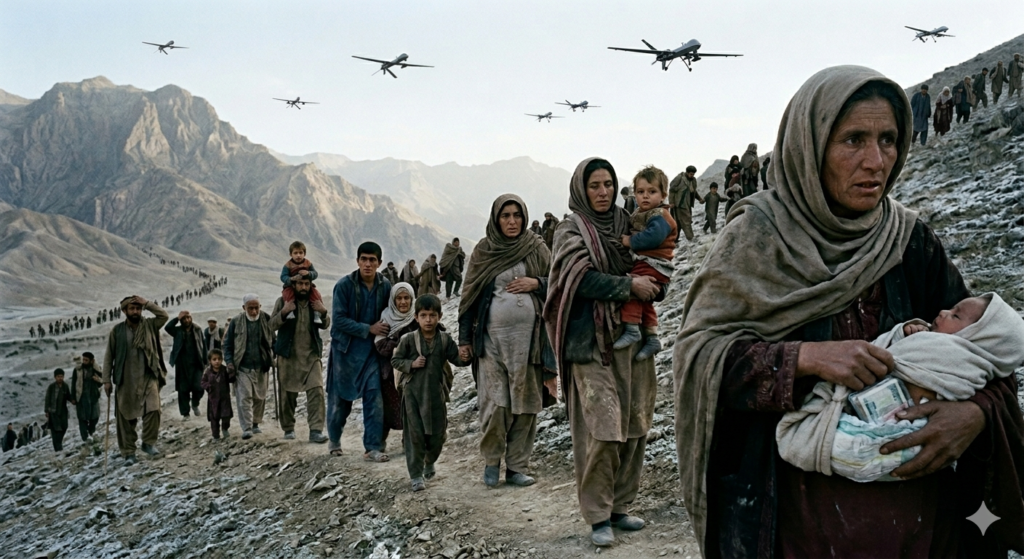
The journey took three weeks. Anas’s father did not travel with the family. Instead, he decided to make the journey separately, by a different route, fearing, Anas says, that American aircraft might be tracking him.
Before they parted, his father entrusted Anas’s mother with half a million dollars, instructing her to hand the money to a man known as Abu Ziad upon arrival so that it could be used to support the families who had already made their way there.
“My mother hid the money inside my infant brother’s diaper,” Anas recalls. “She carried him in her arms the entire time.”
The group making the journey consisted solely of women and children.
Anas says the men travelled by different means, sometimes disguising themselves as members of wedding parties.
“They would hire a bus carrying an Afghan musical group and pay a man and a woman to pose as the bride and groom,” he recalls. “The brothers would put on suits and sit among the wedding party, pretending to be relatives or guests. When the border guards saw a wedding procession, they would wave them through.”
According to Anas, the same method was sometimes used to move weapons and money.
Another method, he says, was to pose as members of Tablighi Jamaat, an Islamic missionary movement whose travelling members were familiar to border guards because of the luggage and blankets they typically carried.
“The border guards knew what they looked like,” Anas recalls. “If they saw a blanket on top of every bag, they assumed they were members of Tablighi Jamaat and let them pass.”
In the Land of the Supreme Leader
Anas, his family, and several other families eventually reached Tehran. But their time in Iran was far from peaceful. According to Anas, a series of developments led the Iranian authorities to turn against the group, detaining some of its members and failing to provide adequate care. He says several people died while in detention.
The detainees staged repeated protests and hunger strikes over their treatment. At the same time, Anas says, after the organisation learned what was happening to its members and their families in Iran, its fighters began attacking Iranian border guards in an attempt to pressure Tehran into easing its restrictions on the families. Eventually, according to his account, the Iranian authorities relaxed the restrictions on their movement and later allowed them to leave the country after a period that Anas describes as effectively house arrest.
The families subsequently made their way to Waziristan, along the Afghanistan–Pakistan border region.
Anas remembers confronting his father over that decision.
“After we left Iran, I asked him, ‘Why did you choose Waziristan? The Iranian government gave us other options—Turkey, France, Italy and other countries. We could have gone there as refugees, and afterwards we would have been free to decide where to settle, where to travel and how to rebuild our lives.’”
His father’s response stayed with him.
“He told me, ‘There will be many choices I make in my life that you won’t understand or like now. But when you grow older, you will understand them.’”
Years later, after his father’s death and the family’s eventual return to Egypt, Anas says he finally understood what his father had meant.
“I understood why he had made that choice,” he says. “My father believed that if he went elsewhere, the Iranians expected that he would eventually be arrested and handed over to the Americans, while we would ultimately be sent back to Egypt.”
Returning to Egypt, however, proved deeply difficult for Anas. Having grown up almost entirely outside the country, he found himself struggling with a society and culture that were largely unfamiliar to him. The absence of his father made that transition even harder.
“When we arrived in Egypt, we had enormous problems with our relatives because of the cultural and social distance between us,” he recalls. “I was there without my father, and I simply wasn’t prepared for life in Egypt.”
In retrospect, Anas believes his father had anticipated those difficulties and had therefore preferred almost any destination to Egypt.
“My father knew what was likely to happen to us there,” he says. “You may have money in your hands and everything you need, but the place still doesn’t feel like yours.”
He points to others from the same milieu who returned to their countries and were arrested, citing Abu Anas al-Libi as an example. In those cases, Anas says, their extended families often stood by them. His own experience in Egypt, he alleges, was very different.
“Our relatives took our money and my father’s company,” he says. “The capital was spent over the course of twenty years. If only they had used it to expand the company—but instead, the money was spent and divided among them. It was originally yours and your father’s, but you had no way of proving that it belonged to you.”
Anas recalls one conversation with his father shortly before his death. He found him sitting alone, visibly despondent, and asked what was troubling him.
“He told me: ‘Here I am, 52 years old. I have spent thirty of those years in jihad. I gave everything—my family, my personal life, and my money. And now it is all gone.’”
Six months later, Anas says his father was killed.
Four Missiles
Only later does the identity of Anas’s father become clear. He was Abu Hafs al-Masri, whose name has deliberately been withheld until this point in the story.
Six months after the family arrived in Waziristan, Anas was travelling in a car with his father, his brother and his father’s driver when, without warning, his father told the two boys to get out. He then continued the journey without them.
Anas and his brother made their way up the mountain. Less than ten minutes later, they heard an explosion.
“After we got out of the car and reached the house, we heard the sound of a missile strike from an aircraft,” Anas recalls. “We had learned to distinguish the sound of a drone strike from an ordinary explosion. It came in two stages: first a lighter sound, then a much louder blast.”
That day, however, the sound came again and again.
“I heard it once, as usual, and immediately felt that something was wrong. Then I heard it a second time, a third and a fourth. They fired four missiles at a single vehicle. This was in 2009.”
Anas rushed outside, but his brother had already gone ahead.
“I found him sitting on the ground. His cap and his weapon were beside him. He wasn’t moving; he was just staring towards the site of the explosion. I didn’t ask him anything, but I felt something. My mother felt it too.”
The brothers made their way towards the site of the strike. Taliban fighters had cordoned off the area and were preventing anyone from entering.
“We told them we were Arabs, but they still refused to let us through,” Anas recalls. “We asked what had happened. They told us there had been a white vehicle with tinted windows and another jeep carrying one person.”
The description matched his father’s vehicle. As the brothers pieced together what they knew and calculated the time that had passed since they had left him, they realised that their father’s car should have been at precisely that location when the missiles struck.
They spent the rest of that day and the following night waiting, unable to sleep. When they encountered Taliban members the next day, they were warned that remaining in the area could put them in danger and were told to return home.
“We went back, but none of us could sleep,” Anas says. “My mother lit a fire and sat beside it throughout the night. I eventually slept for about an hour. When I woke up, I looked at my father’s mattress. It was exactly as he had left it. At that moment, I knew he was dead.”
By the third day, his father still had not returned.
“My mother said, ‘Your father still hasn’t come back.’ She sensed what had happened, but she was trying to deny it. She asked us to go to the brothers up on the mountain and find out what had happened to him.”
Anas and his brother walked for two hours to reach senior members of the organisation based higher in the mountains. There they met two commanders whom he identified as Abu Saleh and Abu Umama.
“With tears in their eyes, they told us that the man killed in the airstrike was our father.”
Anas remembers an unexpected reaction to the news.
“I don’t think we cried. We couldn’t summon the tears. Something happened to us, but we didn’t know what it was. Of course we were affected, but what we felt most strongly was the enormous responsibility that had suddenly fallen on us.”
His father, Anas says, had been responsible for the wider area in which they lived and had helped oversee the needs of numerous families. His death therefore represented more than the loss of a parent.
“Suddenly, we had become directly involved in the crisis ourselves,” Anas recalls. “We kept asking: Who is going to look after all these families now? Who will organise their affairs—including our own family? My father and several other men had been taking care of them. Now each of those men had disappeared somewhere, and we didn’t even know where they were.”
The Country They Had Never Known
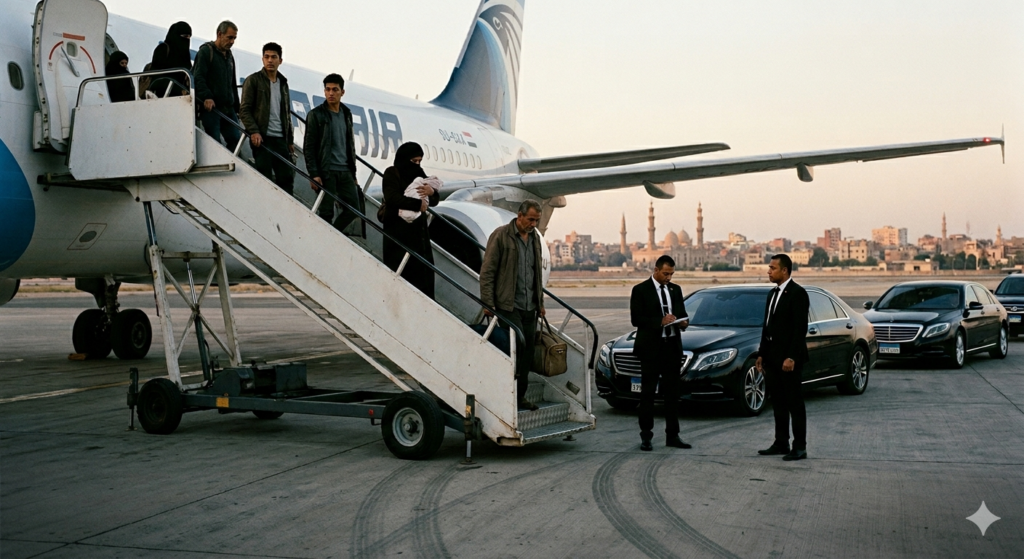
The journey back to Egypt proved almost as difficult as the years the family had spent abroad. After their father’s death, Anas says, neither he nor his family had any desire to remain where they were.
“When we told someone who was in contact with the Egyptian embassy that we wanted to return to Egypt, the matter eventually reached General Omar Suleiman, who was then head of Egyptian intelligence,” Anas recalls. “He took a personal interest in the case and gave instructions to facilitate our return.”
But one major obstacle remained: getting from Waziristan to a Pakistani airport. Anas says the family feared that several intelligence services, particularly the Americans, were tracking them.
According to Anas, Egypt initially agreed to their return on strict conditions.
“The agreement was that my brother and I would spend a year in prison,” he says. “After our release, we would have to report to the authorities every week, in addition to the other restrictions that would be imposed on us.”
But as the paperwork for their return was being processed, Egypt itself was undergoing a historic upheaval: President Hosni Mubarak stepped down.
“The situation was chaotic,” Anas recalls. “We eventually contacted a Pakistani pilot who agreed to get us from Waziristan to the airport for $25,000. That arrangement was for my brother and me. My mother and the rest of my siblings travelled by a different route.”
The family eventually reunited for the journey to Egypt, travelling via Dubai.
“Our documents bore the Egyptian eagle stamp, and the request for our return had been officially approved,” Anas says.
When they landed in Egypt, their arrival was anything but routine.
“We found two black Mercedes cars waiting at the foot of the aircraft stairs. A man wearing dark glasses was standing there. He spotted us among the other passengers and called us over.”
The family was escorted into a private room. Anas recalls that no one else was allowed to handle their luggage. His mother was seated separately and treated, he says, “with the utmost courtesy and respect.”
She was then taken into a private meeting with a senior officer.
Anas says the authorities appeared particularly interested in the children who had grown up within the Arab militant milieu abroad. “They assumed that children returning from there would arrive carrying an intense hatred of the Egyptian authorities,” he recalls.
After the questioning and formalities were completed, however, the family was allowed to leave.
For the first time, Anas was heading home to a country that, until then, he had known largely through the stories of others.
Home, but Still in Exile
Anas says the journey he has lived through left him with reactions and instincts that may seem unusual to those who did not share his experience. He sums them up this way:
“Throughout my life, whenever I saw a military uniform, I associated it with death. Even now, I sometimes still feel that way. I have an instinctive fear of soldiers. I also suffer from a fear of confined spaces because of imprisonment, as well as other things—including, strangely, open spaces, because I was never accustomed to freedom.”
Other traces of that life, he says, remain embedded in his personality.
“I don’t necessarily see them as bad things. I simply lived a very particular kind of life and was raised in a very different way. As a result, I think differently from someone who has lived an ordinary life.”
Anas is conscious of the opportunities he lost along the way—in education, travel, and work. Yet when he compares himself with others of his generation in Egypt, he believes that his unusual upbringing also gave him a different intellectual perspective.
“When I sit with people who plan projects or with intellectuals, I find that I can engage with them very quickly. The same happens when I enter discussions about economics, politics, or the media. I can participate in the conversation and form my own point of view.”
What he feels he lacks, however, is guidance.
Abdel Moneim says that for some children of militant leaders, exposure to violence and displacement ultimately produced the opposite of what might have been expected.
“Some developed a clearer—and sometimes deeper—understanding of what they had lived through than their fathers or even the organisations to which their fathers belonged,” he says.
Distance from the environment in which they were raised can also force a reassessment of inherited beliefs, Abdel Moneim says. Entering a different society and encountering a different set of experiences may create what psychologists describe as cognitive dissonance: a confrontation between previously held beliefs and a new reality.
For some, he says, that rupture becomes the beginning of a profound intellectual and psychological re-evaluation. Others remain unable to escape it.
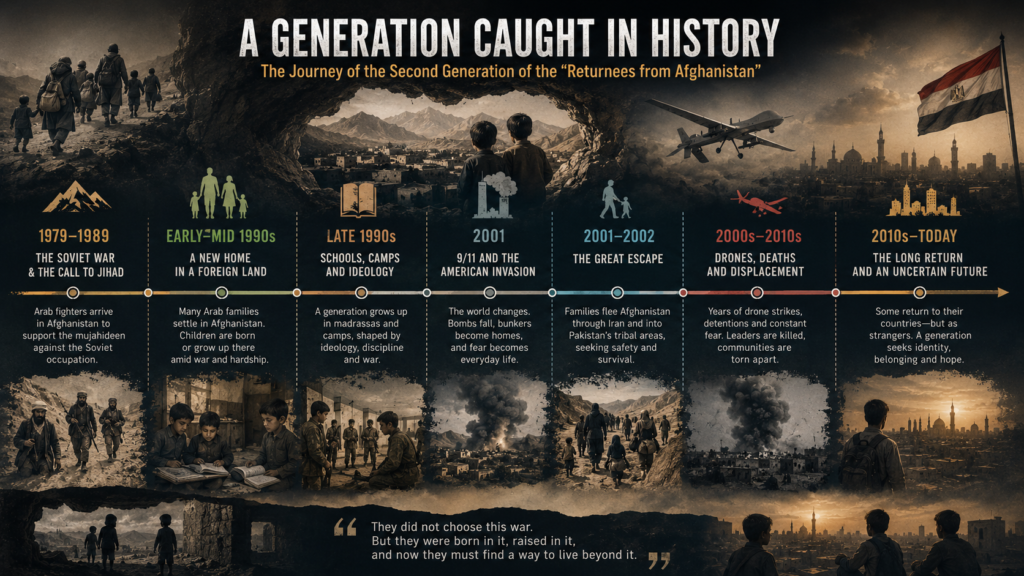
“I need someone who can steer me towards the right path, and that is what I lost when I lost my father. When we need someone to guide us, there is no one there. So we have learned to rely on ourselves.”
Anas does not present himself simply as a victim of the world in which he grew up, nor does he deny the choices he later made as an adult. But his account raises a more difficult question about responsibility: where does inherited circumstance end and individual agency begin for children raised inside armed movements?
His story cannot answer that question for an entire generation. It can, however, reveal what political histories and security files often leave out—the childhood that came before the adult.
For Anas, Afghanistan never entirely ended. Kandahar remains in memories of childhood, training camps, bomb shelters, his father’s radios and the strike that eventually killed him. Returning to Egypt ended the journey, but not its consequences.
Today, as children across the Middle East again grow up amid war, displacement and uncertainty, his story carries a wider warning. The conflicts, causes and actors are different, but one truth endures: wars outlive the battlefields on which they are fought.
Adults may choose wars. Children inherit them — and can spend a lifetime trying to leave them behind.