Trigger Warning:
This investigation contains graphic descriptions and imagery related to extreme violence. Some content may be distressing or emotionally challenging for readers.
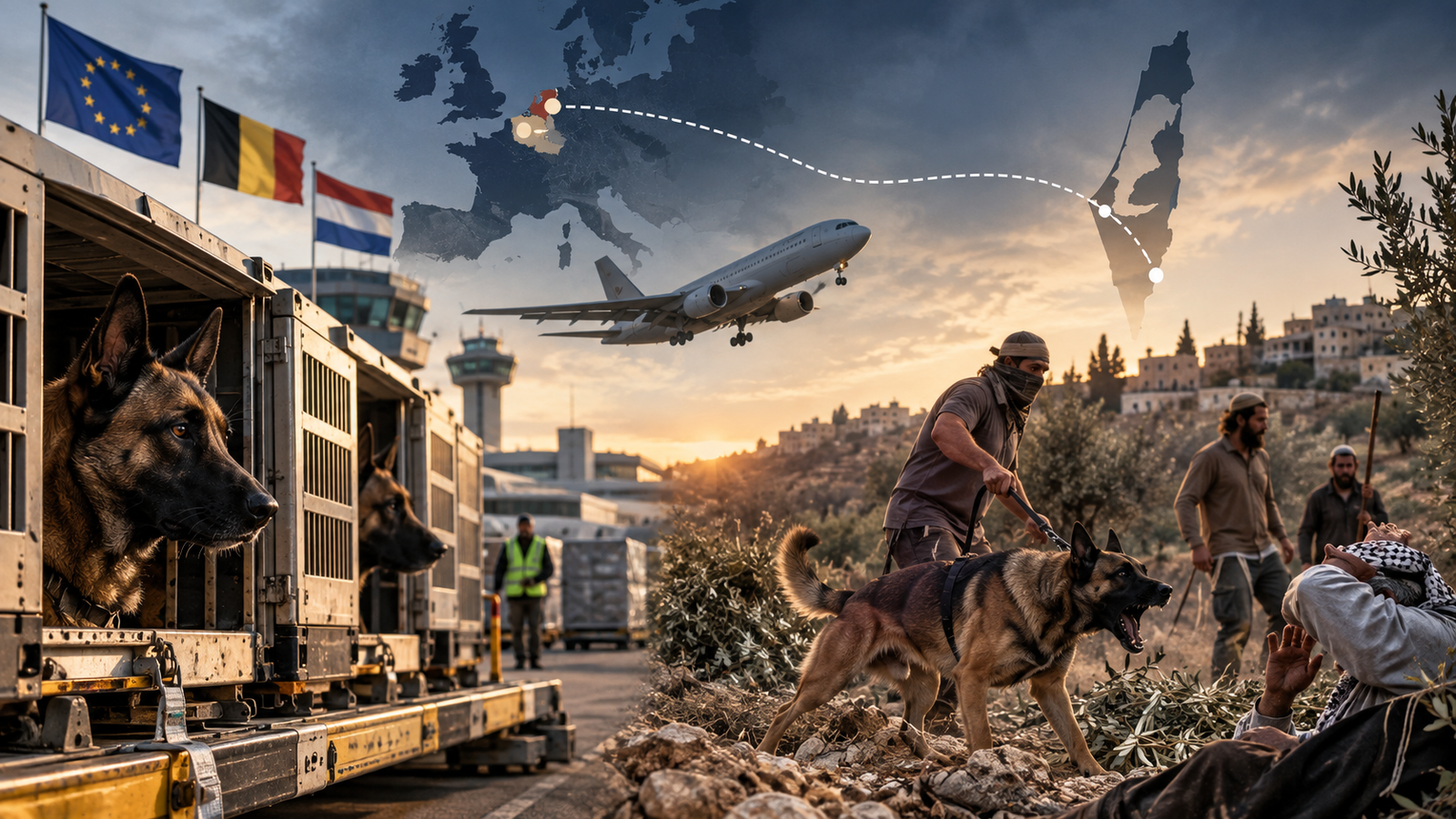
This investigation reveals how the Israeli settlers are using attack dogs, exported from Belgium and the Netherlands, as weapons against Palestinian civilians in the occupied Palestinian territories, in the West Bank.
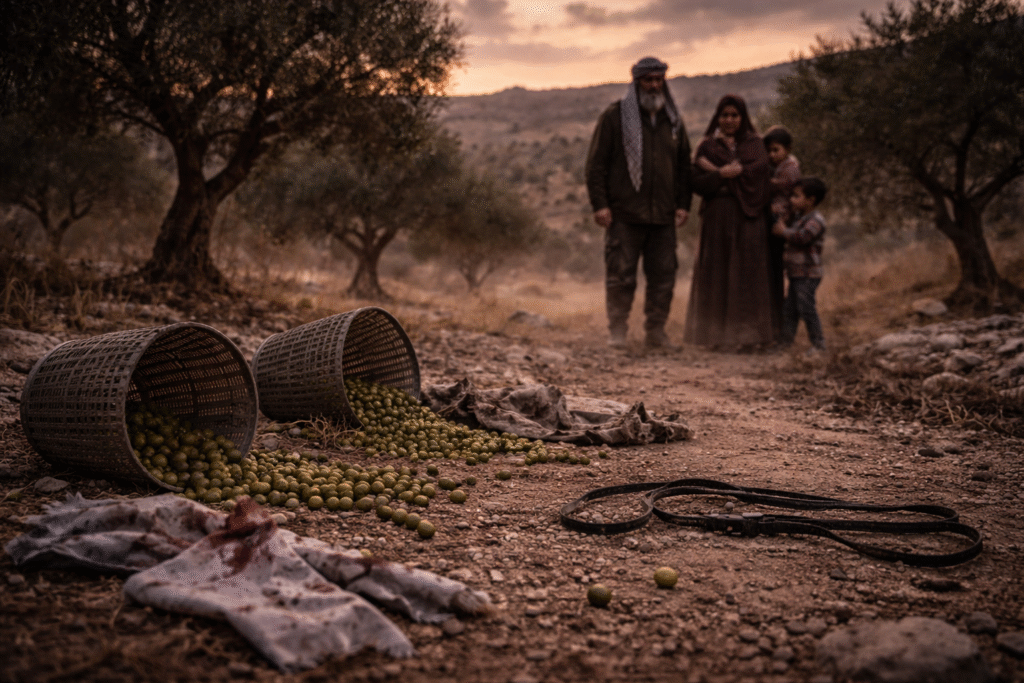
On the morning of 25 October 2025, the olive harvest had just begun in the Palestinian village of Deir Nizam, northwest of Ramallah. Three generations of the Tamimi family had spread blankets beneath the trees, picking olives as they had done for decades.
Then the settlers arrived.
“There were three of them,” recalls 64-year-old Fadel Abdel-Hamid Tamimi. “One carried an M16 rifle. The others had pistols.”
Four dogs ran ahead of them.
Within minutes, the animals had surrounded the family. One settler threw the family’s lunch towards the dogs. When Fadel’s sister tried to retrieve the food, he says the settler slapped her across the face. The confrontation escalated immediately.
“The settler made a hand signal,” Fadel says. “That’s when the dogs came towards us.”
For nearly twenty minutes the family remained trapped between armed settlers and four snarling dogs.
His son Hamza still remembers the animals in remarkable detail.
“They were Belgian Malinois,” he says. “Large, muscular, moving together like trained police dogs.”
When Israeli soldiers eventually arrived, the family expected protection. Instead, according to Fadel, the soldiers ordered the Palestinians to leave while allowing the settlers to remain. Tear gas and live ammunition forced the family from the grove. Their olives, food and equipment were left behind.
The attack was not an isolated incident. Across the occupied West Bank, Palestinian farmers, shepherds and rural communities increasingly describe encounters with settlers accompanied by trained protection dogs. Human rights organisations, including B’Tselem, Al-Haq and the UN Office for the Coordination of Humanitarian Affairs (OCHA), have documented multiple cases in which dogs have been used during assaults on Palestinian civilians, livestock and homes.
But where do these dogs come from?
The Network Behind the Teeth
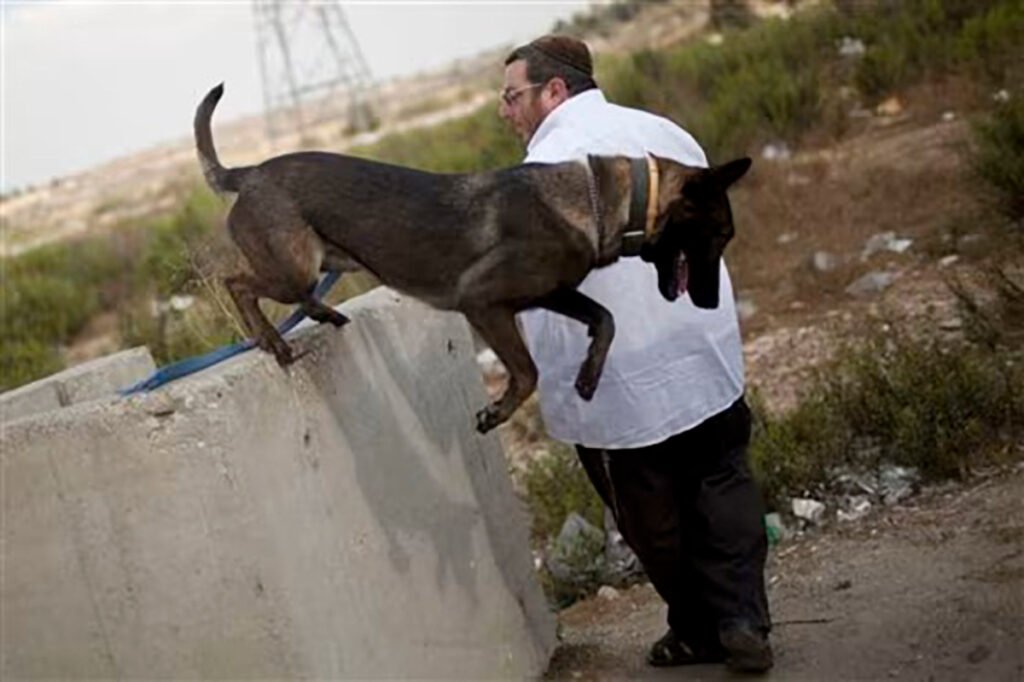
Interviews with trainers in Belgium, direct correspondence with Israeli dog handlers, archived company records and official documents reveal that working dogs bred and trained in Belgium and the Netherlands have been imported into Israel for years, becoming part of a civilian canine network operating in and around Israeli settlements in the occupied West Bank.
The network is led by the Israel Dog Unit (IDU), known previously as IBF, a volunteer organisation that presents itself internationally as a humanitarian search-and-rescue service. Yet its activities extend far beyond locating missing hikers.
Over time, the IDU evolved through multiple names. Early versions included the “Jewish Legion” and “Israel’s Best Friend” (IBF), branding that enabled fundraising and outreach under less politically charged labels.
In a video for the IBF (IDU now), we see dogs at West Bank outposts being trained and conditioned to attack targets depicted as Arabs and Muslims.
Video of Yekutiel “Mike” Guzofsky showing dogs being trained at West Bank outposts. (Wayback Machine)
The accompanying description of the video went further: “Muslim Terrorists, who consider dogs unclean, fear our Malinois and Dobermans more than they fear firearms and airstrikes,” asserts the text posted on YouTube.
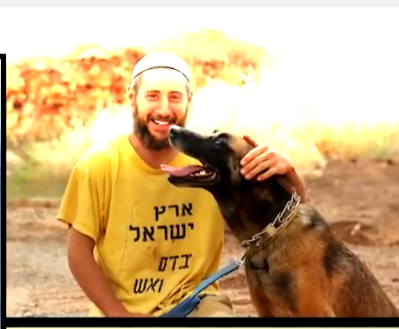
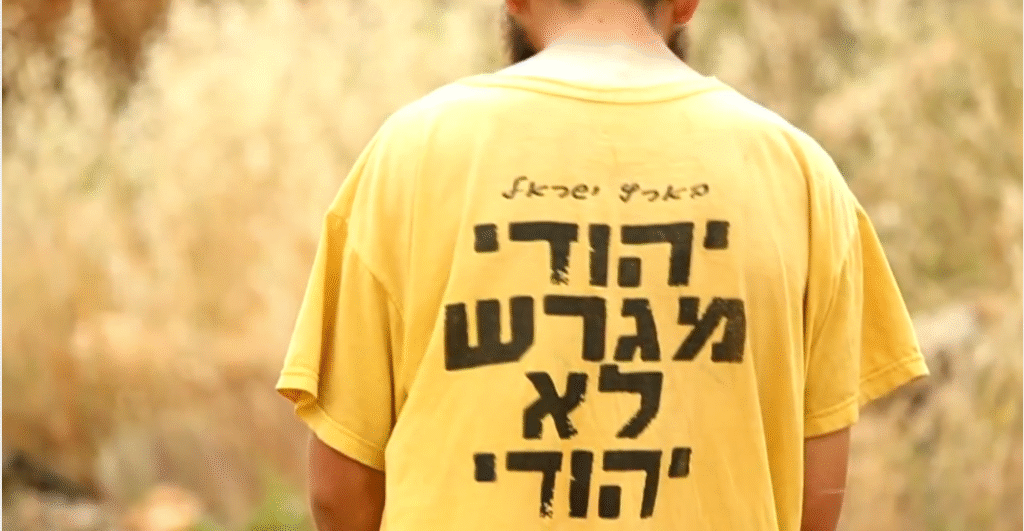
The IBF (IDU now) training videos unabashedly framed the dogs’ purpose as targeting Arabs/Muslims. Trainees in Guzofsky’s program were even shown wearing extremist slogans on T-shirts – one shirt read “The Land of Israel by blood and fire” on the front and “Jews expel non-Jews” on the back.
From European Kennels to Palestinian Villages
The Israel Dog Unit occupies an unusual position inside Israel’s security landscape.
Unlike the army’s elite Oketz canine unit, it is formally a volunteer organisation. It promotes itself as a humanitarian search-and-rescue service, locating missing hikers, assisting police searches and responding to natural disasters. Those activities have earned the organisation public recognition from Israeli authorities and helped build an image of a civilian rescue charity.
But that is only part of the story.
The organisation also trains and deploys protection dogs to civilian communities across the occupied West Bank. On fundraising platforms and its own website, the Israel Dog Unit describes security dogs as an “active deterrent system” protecting settlements and rural outposts. Campaigns inviting donors to sponsor a dog promise to help defend families living in what Israel calls Judea and Samaria.
Crowdfunding campaigns published by the organisation state that more than 300 security dogs have been placed in settlements throughout the territory
According to its Hebrew Wikipedia page, the Israel Dog Unit operates with approximately 400 nationwide volunteers, maintaining a dual canine force of roughly 75 protection dogs for town security and 25 specialized dogs for search, tracking, and recovery. The figures underline the IDU’s dual structure: humanitarian rescue work alongside a civilian protection-dog programme.
Its founder, Yekutiel “Mike” Guzofsky, has spent decades promoting armed civilian self-defence.
Born in New York, Guzofsky joined Rabbi Meir Kahane’s Jewish Defense League before emigrating to Israel in the early 1980s. He later became a senior figure in Kahane Chai, the successor to Kach, organisations designated as terrorist by both Israel and the United States. During the Second Intifada, he established what would eventually become the Israel Dog Unit, combining dog training with civilian security initiatives in Israeli settlements.
Over time, the organisation increasingly emphasised its humanitarian activities. Search-and-rescue missions became central to its public image, helping attract volunteers and donations from Israel and abroad.
Its security role, however, never disappeared.
The organisation continues to raise money specifically for protection dogs deployed in settlements, while presenting those animals as an essential layer of civilian defence.
Support comes from well beyond Israel.
Diaspora organisations in the United States publicly fund projects connected to the Israel Dog Unit, including campaigns allowing donors to sponsor individual security dogs.
Public fundraising records show how that security programme is supported from abroad. Am Yisrael Chai lists the Israel Dog Unit among its projects and reports more than $681,000 in support since 2018, while a campaign hosted by The Chesed Fund invites donors to “sponsor a dog” to protect families in Israeli settlements in the West Bank.
Guzofsky has also linked fundraising directly to European imports. Speaking on the Thirty-Six podcast, he said: “I was in the States to raise money to pay for the dogs that we had just brought in from Europe, from Belgium and Holland, to pay the trainers.”
Following the outbreak of the Gaza war, Guzofsky also announced plans to expand the organisation’s activities abroad, offering trained dogs and handlers to Jewish communities in Europe and North America after football match clashes in Amsterdam in November 2024.
“We will never say no to any Jew in distress,” he told Israeli media. He also noted that IDU already has strategic partners in Holland and Belgium ready to assist.
The announcement illustrates how a network built around Israeli settlements increasingly reaches beyond Israel itself.
For Palestinians living nearby, however, the immediate concern is not international expansion but daily life.
The European Complicity
In other words, a relatively small number of European working dogs became breeding stock inside Israel, producing generations of descendants whose exact destinations can no longer be traced. That admission offers a rare glimpse into a largely unregulated trade operating far from public scrutiny.
‘’There are no permit/license requirements for the export of dogs, including working dogs. Dogs are also not listed in the EU Common Military List and the EU Common Dual-Use List’’. The Dutch customs (Douane.nl) in their reply to our email.
Unlike firearms or military equipment, working dogs are exported as animals, not security products. European regulations require veterinary certificates and customs documentation, but no end-user controls comparable to those applied to defence exports. Once the dogs enter Israel, European authorities lose sight of where they ultimately end up.
Jonathan Balcombe, a biologist and author on animal behaviour and sentience, argues that the issue is not only regulatory but ethical. Training social animals to become dangerous in human conflicts, he says, amounts to “a form of weaponization”. Dogs, he stresses, have no agency in the conflicts into which people place them: “We choose to have wars… but the dogs don’t choose to have that.”
That lack of oversight becomes particularly significant when viewed alongside the Israel Dog Unit’s own mission.
Although widely known for search-and-rescue operations, the organisation also trains and deploys protection dogs to civilian communities across what Israel calls Judea and Samaria—the occupied West Bank.
The European connection begins in Belgium and the Netherlands, where working dogs are among the world’s most sought-after exports.
Belgian Malinois, in particular, have become the preferred breed for police forces, militaries and specialist security units because of their intelligence, endurance and obedience, according to Alina Stevenson, dogs’ behavior specialist.
Several people involved in that trade described longstanding relationships with Israeli buyers.
A Belgian dog trainer who worked for years with Belgium Rescue Dogs (BRD) and maintained close contacts with Israeli handlers told us that he travelled repeatedly to Israel to train dogs and instructors connected to Mike Guzofsky’s organisation. He spoke on condition of anonymity.
“I’ve been involved with that a lot,” he says. “Mainly through Belgium Rescue Dogs. We went there to help with search operations and training.”
He later provided a certificate issued by the Israel Dog Unit identifying him as a “Master Canine Instructor” responsible since 2012 for training handlers and dogs in search-and-rescue, tracking and protection.
The relationship, he says, extended beyond occasional visits.
“I have already, for approximately fifteen years, trained and delivered guard dogs, cadaver dogs and rescue dogs to Israel.”
In a separate exchange, the trainer added: “Most of it you won’t find back on the web. The Israeli people are sensitive about that.” His account does not establish where each dog ultimately went or how it was later used, but it illustrates how difficult the European-Israeli working-dog trade is to reconstruct from public records alone.
According to the trainer, transporting the animals followed an established route.
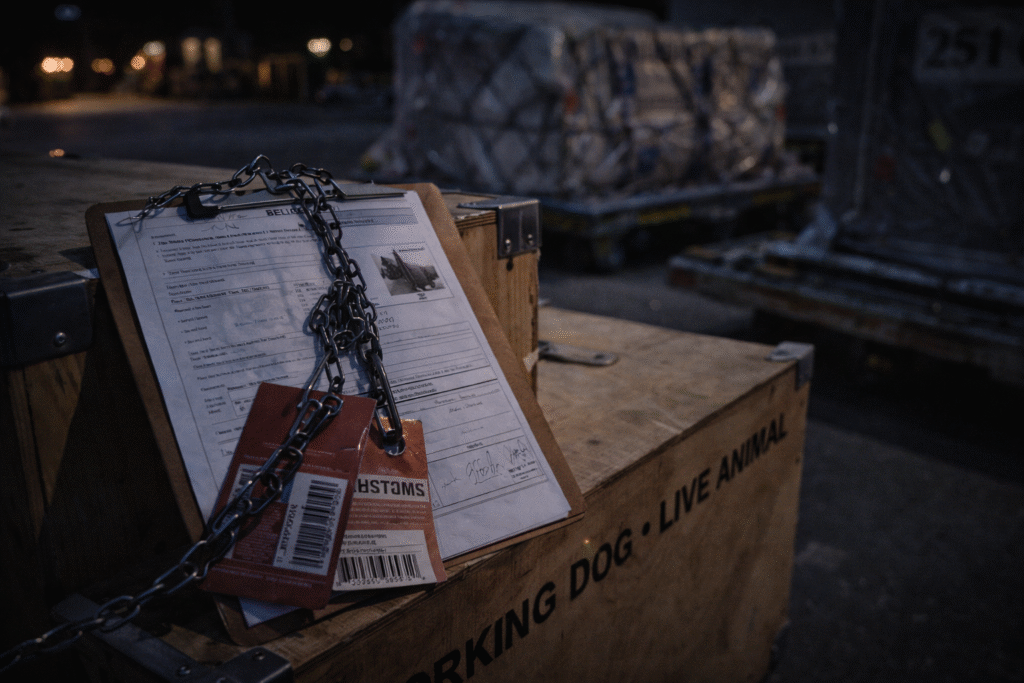
“They always fly through Schiphol with El Al,” he explains. “The vaccinations have to be correct, everything checked and sealed by an authorised veterinarian.”
Asked where those veterinary procedures took place, his answer was brief.
“Belgium.”
The investigation also uncovered historical links between the IDU and LiSAR, a Dutch search-and-rescue training company repeatedly mentioned during interviews.
According to the Belgian trainer, LiSAR introduced him to Mike Guzofsky years earlier through joint training activities in Israel.
Archived versions of LiSAR’s website support the existence of those contacts. Among its international partners, the company listed an organisation identified as “IC K9 Unit Israël” — a designation closely resembling the name used by the Israel Dog Unit during its early years as the “Israel Civilian K9 Unit.”
When contacted, LiSAR firmly rejected any suggestion that it had trained attack dogs or participated in exports for military or settlement purposes. The company’s former owner, who says the business ceased operations around two years ago, stated that LiSAR worked exclusively on humanitarian search-and-rescue missions and denied supplying, training, or exporting protection dogs to the Israel Dog Unit or any military framework.
Dozens of Offspring
The clearest evidence comes from the organisation’s founder himself.
Responding to written questions, Mike Guzofsky confirmed that his organisation had imported working dogs from Belgium and the Netherlands over several years.
“We imported over the years 15 or so dogs from Belgium and Holland. They are good. And we have bred some. They have had dozens of offspring… saved many lives here.”, Mike Guzofsky said in an email to us.
The significance of his admission lies not only in the imports themselves.
“They have had dozens of offspring,” he added.
When asked whether Belgian breeders were involved, Guzofsky did not deny the relationship.
“I need to get the OK from the local Belgian people we dealt with. There were at least five or six different lines from Belgium and Holland.”
The statement suggests that the imports were not isolated purchases but part of relationships with multiple European breeders extending over several years.
A Belgian Malinois can be trained for police work, military operations, private security or search-and-rescue. Once exported, the same animal may change ownership several times or be bred inside another country, effectively disappearing from European oversight.
Industry specialists estimate that fully trained protection dogs can sell for between $15,000 and $ 25,000 depending on their level of training.
For specialist breeders, Israel represents an attractive market with sustained demand for high-performance working dogs.
Belgium’s Federal Agency for the Safety of the Food Chain (FASFC), responsible for veterinary export certificates, declined repeated requests for data identifying the number of working dogs exported to Israel.
The agency initially argued that collecting the information would require an unreasonable amount of work. After the request was narrowed and later pursued through Belgium’s Federal Ombudsman, the refusal remained unchanged.
As a result, Belgian authorities cannot—or will not—say how many working dogs have left the country for Israel since the start of the war in Gaza.
That lack of transparency highlights a wider regulatory gap.
Yet according to Guzofsky himself, that is precisely what happened.
A relatively small number of imported dogs became the foundation of a much larger canine network inside Israel.
What can be independently documented is a broader pattern of settlers using dogs against Palestinians and their livestock across the occupied West Bank.
They Set the Dog on My Leg
Nearly 50 kilometres south of Deir Nizam, shepherd Sari Jarradat, 38, says dogs have become part of the violence forcing Palestinian families from their land.
His family used to live east of Kisan, on grazing land overlooking a cluster of Israeli outposts.
The harassment began with shouting and intimidation. Then, he says, settlers arrived with dogs.
“They put the dog on my leg,” Jarradat recalls. “It started biting immediately.”
According to Jarradat, the settlers used a chicken to excite the animals before releasing them. During a second attack two weeks later, five dogs accompanied the group. His wife, Soumaya, 39, was bitten, beaten and exposed to tear gas. While he was being detained by Israeli soldiers, he says, settlers returned and burned down the family’s tent.
The family left that night.
Their experience mirrors a broader trend documented by the United Nations.
Since October 2023, escalating settler violence has displaced more than 4,000 Palestinians across the occupied West Bank, according to the UN Office for the Coordination of Humanitarian Affairs. Entire Bedouin and herding communities have abandoned areas where repeated attacks made daily life impossible.
Human rights organisations have documented numerous incidents involving dogs used during assaults on Palestinian farmers and shepherds.
Once animals enter Israel, they may be sold, transferred, bred or trained again without any public record.
That evidentiary limit is important.
At the same time, the broader picture is considerably clearer.
Mike Guzofsky acknowledges importing working dogs from Belgium and the Netherlands. Trainers describe years of cooperation between European breeders and Israeli handlers. Certificates confirm long-standing training relationships. Archived records document institutional contacts. Fundraising campaigns openly advertise the deployment of security dogs in settlements.
Taken together, those pieces reveal a European supply chain feeding a civilian canine network operating in occupied territory.
The regulatory system has struggled to keep pace.
Belgium was unable to provide export figures. The Netherlands imposes no end-user controls on exported working dogs. Once veterinary certificates have been issued and customs procedures completed, European oversight effectively ends.
The dogs continue their journey.
Some become police dogs. Others work in search-and-rescue. Others, according to the Israel Dog Unit’s own statements, are deployed to settlements across the occupied West Bank, where Palestinians increasingly describe them not as rescue animals but as another weapon used to drive them from their land.
The story therefore extends far beyond the violence in a single olive grove or a single shepherd’s camp.
It raises a broader European question.
When highly trained working dogs leave European kennels, should authorities know where they ultimately end up?
At present, the answer appears to be no.
Yet as Guzofsky himself acknowledged, the imports did not end at the airport.
“They have had dozens of offspring.”
Those descendants can no longer be traced.
But their impact is increasingly visible across the hills of the occupied West Bank.
This investigation came with the support of Fonds Pascal Decross- Journalism Fund Europe